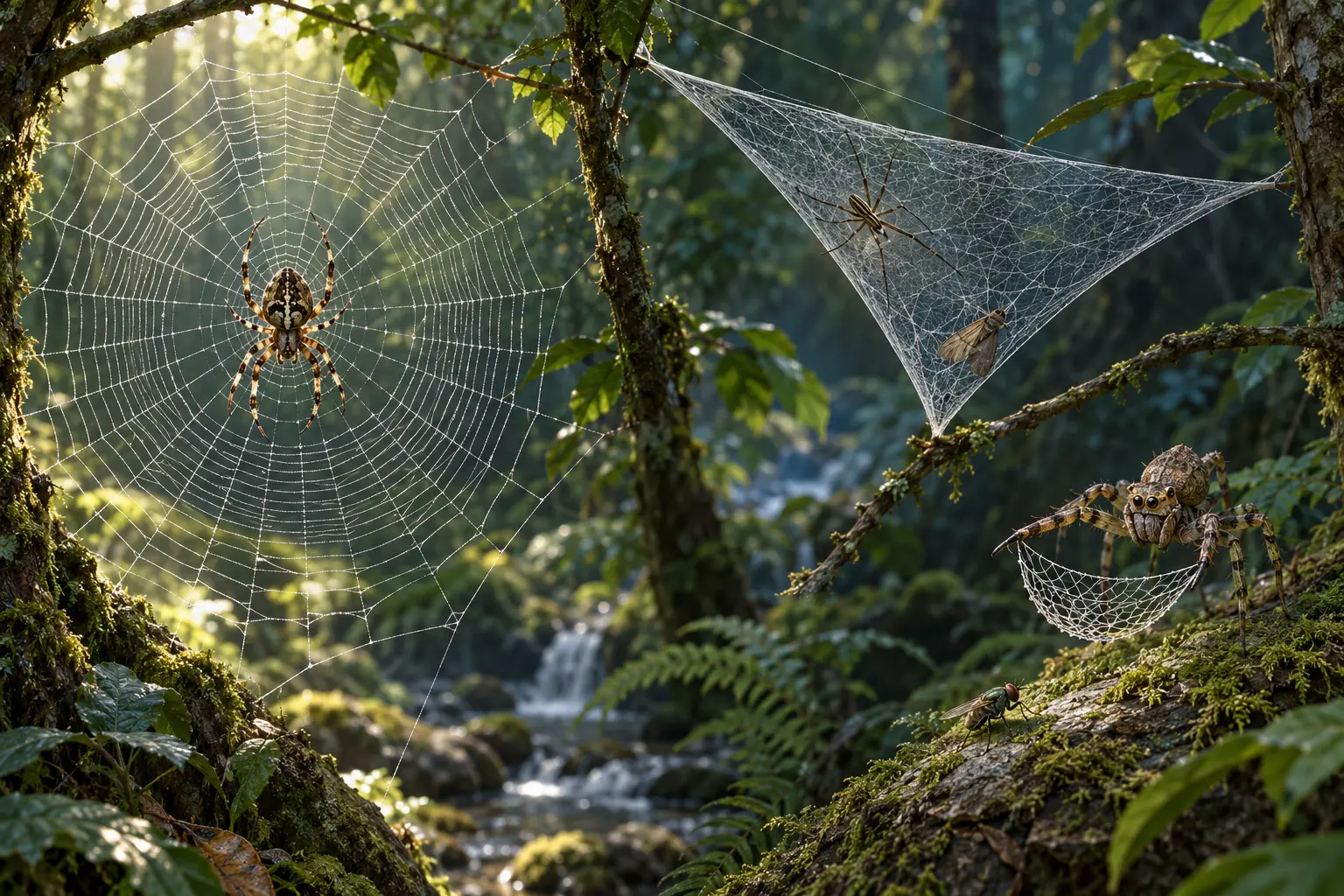
This interpretive overview separates a fixed orb, a tensioned triangle, and a portable capture net. The guides below pair explanatory artwork with credited field photographs and direct scientific sources.
SPIDERS, SILK, AND SCIENCE
Read in order for a biology-to-physics learning path, or start with the question that interests you. The articles pair real photographs with explanatory illustrations, source references, and videos with observation notes.
A clear field-guide overview of spider body plan, vibration sensing, predatory diets, and the many non-web uses of silk—written for WebTug readers.
READ GUIDE →02 · DEVELOPMENT + HABITATSpider life cycle and habitatHow spiders develop from egg sac to adult, why molting matters, how ballooning works as dispersal, and why habitat is an engineering constraint on silk strategy.
READ GUIDE →03 · FIELD PROFILESSix silk strategiesField profiles for Shamrock orb-weaver, triangle weaver, ogre-faced net-caster, bolas spider, western black widow, and Adanson’s house jumper—real silk use versus game visuals.
READ GUIDE →04 · MATERIALS SCIENCESpider silk as a materialHow spidroins become fibers in the spinning duct, why toughness is not the same as strength, a silk-systems table, and careful steel-comparison caveats.
READ GUIDE →05 · ARCHITECTUREWeb architectures as machinesHow orb, triangle slingshot, casting net, bolas, gumfoot, and dragline architectures route force—geometry and pretension as much as fiber chemistry.
READ GUIDE →06 · SCIENCE + PLAYPhysics teaching vs the gameKinetic energy, stress and strain, spring energy, and pendulum analogies—plus the exact fixed accelerations WebTug uses and how they differ from biology.
READ GUIDE →WATCH SPIDERS BUILD, HUNT, AND GROW
Each link opens the film beside its scientific explanation. Videos load when you choose to watch; the written visual summaries are available without playback. The species label explains when a film shows a relative rather than one of the six roster spiders.
- Beautiful Spider Web Build Time-lapse · 4:36
BBC Earth - Catapulting spider winds up web to launch at prey: study · 0:37
AFP News Agency · research footage - Ogre-faced, net-casting spiders catch prey in dark of night · 2:42
Cornell University · Jay Stafstrom - Bolas Spider · 1:06
Content Mint / Absolutely Wild Visuals - Why the Male Black Widow is a Real Home Wrecker · 5:49
KQED / PBS Deep Look - This Jumping Spider Trains Itself to Kill · 4:47
KQED / PBS Deep Look - Watch This Tarantula Crawl Out of Its Own Skeleton · 1:11
National Geographic - 20 MILLION Year-Old Spider and the Science of Spider Silk · 7:44
PBS Be Smart · Cheryl Hayashi - Turret Spiders Launch Sneak Attacks From Tiny Towers · 4:35
KQED / PBS Deep Look
THREE WAYS TO EXPLORE
Start with reading a photograph. Find the two body regions, then compare a real spinneret close-up with the anatomy illustration. Finish with egg sacs, spiderlings, and a molt.
Read the worked fiber calculation, watch the silk researcher’s explanation, and trace an orb’s force paths. In the lab, change one input at a time and describe what changes.
Compare the six photographed spiders and hunting films with their lab modes. Then read the science-to-game comparison before trying the one-button arcade model.
START WITH THE PROBLEM YOU WANT TO SOLVE
The quickest path is the visual lesson if the spider keeps dropping after tiny taps. Use the physics guide when you want exact numbers, the fairness report when a gap sequence looks suspicious, and troubleshooting when an input or saved score behaves differently than expected.
Choose Classic, a spider challenge, or River Shelter. Follow the controls with captions, chapter shortcuts, and four playback speeds.
READ GUIDE →MEASURED MOVEMENTWhat one web hold doesFollow acceleration, speed limits, visible web travel, and two worked timing examples.
READ GUIDE →INTERACTIVE SCIENCESix ways spiders turn silk into a machineCompare impact absorption, elastic release, a casting net, a bolas, a gumfoot spring, and a stabilizing dragline.
READ GUIDE →20,000-PAIR TESTHow the forest stays reachableInspect the generator constraints, portrait test method, results, and limitations.
READ GUIDE →SCENARIO PLAYBOOKRead two openings aheadChoose a response for low entry, fast fall, high rise, reversals, and emergency recovery.
READ GUIDE →RULES & MILESTONESEvery point and medal explainedUnderstand scoring, the exact 10/20/30/40 thresholds, local bests, and challenge links.
READ GUIDE →PHONE & TABLETPortrait, landscape, and touchCompare usable space, hand position, browser chrome, keyboard controls, and rotation.
READ GUIDE →DEVICE HELPFix input, audio, score, or display issuesRun short checks without clearing data first, then learn what information helps diagnose a problem.
READ GUIDE →FIRST-HAND HISTORYDevelopment notesSee dated changes to reachability, challenge links, visual polish, and the learning library.
READ GUIDE →WHAT THESE GUIDES CAN—AND CANNOT—PROMISE
The explanations describe the current WebTug build and are revised when the underlying behavior changes. They can explain why an input tends to produce a path, but they cannot give one perfect beat: the next opening and the spider’s entry velocity both vary. That uncertainty is the game.
The Spider Physics Lab is deliberately separate. Its comparative models demonstrate real silk uses with stated simplifications; changing them never changes the arcade movement, collision box, score, body motion, or shared web-travel time.