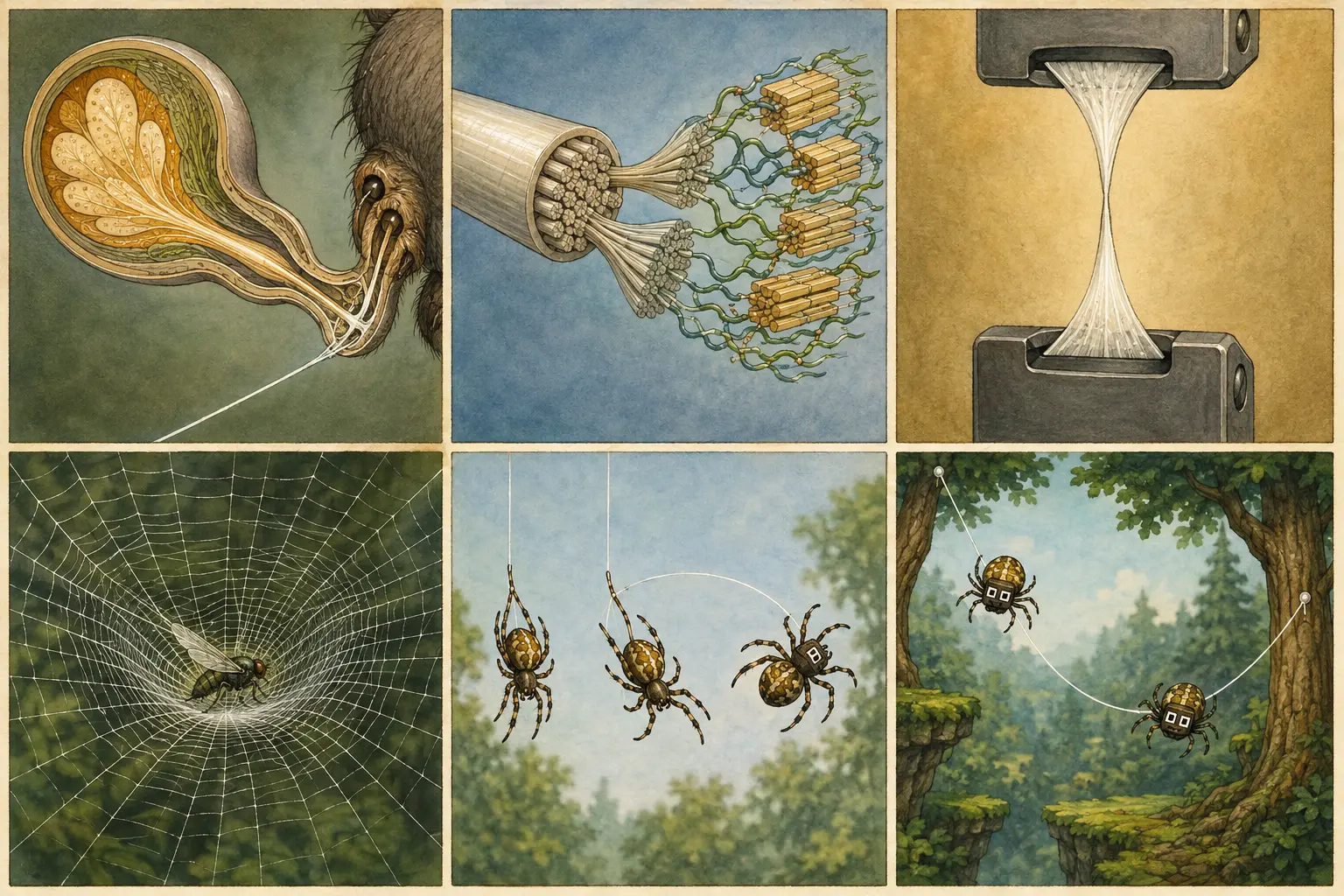
These explanatory illustrations show structures and mechanical ideas. The field photographs within the article record real spiders; each has its own species label, observation notes, photographer credit, and reuse license.
Spider silks are protein fibers assembled mainly from large repetitive proteins called spidroins. The proteins are stored in concentrated liquid form inside specialized glands, pass through a narrowing duct, and become solid fibers as chemistry, shear, water removal, and molecular alignment change. Performance is not a single magic number. It emerges from molecular organization, spinning conditions, and which gland system produced the thread.
This page expands WebTug’s materials-science chapter. It keeps the site’s published comparison values and footnotes instead of turning “stronger than steel” into marketing copy.
Why this matters
Engineers and students often meet silk through a slogan. The useful claim is narrower and stronger: some dragline silks combine high tensile strength with large extensibility, yielding exceptional toughness—energy absorbed before fracture—while remaining much less dense than steel. Understanding strength versus toughness, and knowing which silk system you are talking about, is the difference between materials literacy and trivia.
From gland to fiber

Spinneret detail on a female Argiope bruennichi photographed near Pisa, Italy.
Look closely: Locate the small spinneret structures where the line leaves the abdomen. A photograph can show the outlet and thread, but it cannot identify the protein composition or breaking strength by appearance.
Photo: Lucarelli · CC BY-SA 3.0 · Original / license record. Resized and converted to WebP; original composition retained.

A wasp spider (Argiope bruennichi) releases many silk threads while wrapping prey.
Look closely: Many fine strands emerge together near the rear of the abdomen. This is an external view of silk use; the glands and changing chemistry inside the body are not visible. This wasp spider is an additional biology example.
Photo: GeraldH51 · CC BY-SA 4.0 · Original / license record. Resized and converted to WebP; original composition retained.
Inside the gland, spidroins sit as a concentrated spinning dope. Along the duct, several things change together:
- Geometry narrows, raising shear and alignment.
- Water is removed.
- Chemical environment shifts.
- Protein chains organize into a solid fiber with ordered and more flexible regions.
Ordered regions help reinforce the network; more flexible regions help the fiber deform without failing immediately. Silk performance is therefore a structure–process–property story: sequence motifs, spinning path, and test conditions all matter.
The explanatory plate above is an illustration, not a lab micrograph. For mechanical-design framing from fibroin sequence to function, the site links Gosline and colleagues’ Journal of Experimental Biology paper.
Strength is not toughness
A tensile test records force and extension. Three different summaries answer different questions:
- Tensile strength is the maximum engineering stress reached in a tensile test. For a fiber that fails at its peak load, it is also the stress at failure.
- Extensibility / strain at failure asks how far it stretches relative to original length.
- Toughness asks how much energy per volume the fiber absorbs before breaking—the area under the stress–strain curve.
A material can be strong but brittle (high stress, tiny strain, little energy absorbed). Another can be moderately strong, highly extensible, and extremely tough. Dragline silk’s reputation comes largely from that combination, not from beating every steel on every metric.
Engineering definitions used on WebTug
- Engineering stress: σ = F / A₀ (force over initial cross-sectional area)
- Engineering strain: ε = ΔL / L₀ (length change over initial gauge length)
Thin fibers can show high stress even when absolute force is small. Always check whether a popular comparison normalized by area, by weight, or by something looser.
Published silk-versus-steel comparison (with caveats)
WebTug’s materials chapter reports published comparison values for major-ampullate silk from Araneus diadematus and a selected high-tensile steel—not universal constants:
| Property | Dragline silk (reported comparison) | Steel benchmark (reported comparison) |
|---|---|---|
| Tensile strength | about 1.1 GPa | about 1.5 GPa |
| Strain at failure | about 27% | about 0.8% |
| Energy absorbed before fracture | about 160 MJ/m³ | about 6 MJ/m³ |
Source: Gosline et al. (1999), Table 1. The steel entry is a high-tensile benchmark, not a representative value for every steel grade or treatment.
Footnotes that must travel with the table:
- These are specific published comparison values—not a claim that every spider silk outranks every steel.
- Silk properties change with species, individual, humidity, diet, spinning conditions, strain rate, and test method.
- Density matters for structural efficiency: silk is far less dense than steel, which changes mass-specific comparisons.
- Real silk is nonlinear and dissipative; a single modulus is a teaching simplification.
If you only remember one sentence: silk’s exceptional feature is often toughness and extensibility together, not a universal “stronger than steel” slogan.
Silk systems table
Different glands produce fibers optimized for different jobs. The comparison below is the teaching core:
| Silk system | Typical job | Engineering emphasis |
|---|---|---|
| Major ampullate | Draglines and orb-web frames | High tensile strength plus useful extensibility |
| Flagelliform + aggregate | Sticky capture spiral | Very extensible core coated with wet adhesive glue |
| Aciniform | Wrapping and securing prey | Tough fibers produced rapidly during immobilization |
| Tubuliform | Protective egg-sac casing | Stiff, durable fibers made by adult females |
| Pyriform | Attachment discs | Cements a line to bark, leaves, stone, or another thread |
This is a selected cross-group comparison, not a complete list or a gland inventory possessed by every spider. Flagelliform-plus-aggregate capture spirals describe many familiar ecribellate orb-weavers. Cribellate spiders, including triangle weavers and net-casters, instead use fine, dry capture fibers; not all capture silk is coated in wet glue.
A typical glue-spiral orb is therefore a composite machine: major-ampullate radii for load paths, flagelliform-plus-glue spiral for retention and local deformation, pyriform discs for anchors. A jumping spider’s dragline leans on major-ampullate performance without needing a sticky spiral at all. A widow’s gumfoot system depends on adhesive lines plus the compliance of a three-dimensional tangle.
Humidity, rate, and history
Even within one silk type, response depends on:
- Humidity (especially for capture glues and some fiber viscoelasticity)
- Strain rate (impact is not a slow lab pull)
- Loading history (prior stretch, damage, or relaxation)
- Geometry (diameter, length, and how many threads share load)
That is why the Spider Physics Lab’s stiffness and damping sliders are comparative teaching controls, not claims about one species’ exact modulus. Increasing “stiffness” in the lab makes the simplified restoring force grow faster; increasing “damping” generally reduces oscillation. Beyond critical damping in a linear oscillator, more damping can slow the return to equilibrium, so “more damping” does not always mean “settles fastest.” The source and model boundary under each mode state what the visual leaves out.
Worked example: a fine fiber under tension
How can a small force create a large stress?
Imagine a circular fiber with an initial diameter of 5 micrometers, carrying 0.010 newtons. These are invented teaching inputs, not a test of a photographed spider.
- Initial area: A₀ = πd²/4 ≈ 1.96 × 10⁻¹¹ m².
- Engineering stress: σ = F/A₀ ≈ 5.1 × 10⁸ Pa = 0.51 GPa.
- If a 10 mm gauge length becomes 12 mm, engineering strain is (12 − 10)/10 = 0.20, or 20%.
Double the initial diameter while keeping force the same, and the area becomes four times larger: the engineering stress falls to about 0.13 GPa. This is why a “holds this much weight” demonstration needs a measured cross-section before it becomes a strength comparison.
Neither one stress value nor one extension tells you toughness. For that, measure the stress–strain curve through fracture and integrate the area underneath it. The silk-versus-steel table above reports results from particular published comparisons.
How WebTug maps (and doesn’t)
Maps
- Homepage Chapter 04 numbers, caveats, and silk-systems table match this article.
- Lab demos treat silk use as different machines built from related materials.
- Species profiles change silk drawings, not material constitutive laws inside the arcade game.
Doesn’t
- WebTug Classic movement does not integrate a nonlinear silk constitutive model.
- The visible 0.12 s web-travel animation does not gate the arcade lift force.
- Selecting a widow or orb-weaver does not assign different tensile strengths in play.
For architecture—how threads are arranged into force paths—read Web architectures as machines. For the arcade accelerations, read game physics.
Sources
- Gosline et al. (1999): The mechanical design of spider silks: from fibroin sequence to mechanical function, Journal of Experimental Biology; Table 1 supplies the comparison values.
- Heim, Keerl, and Scheibel (2009): The elaborate structure of spider silk — gland products and fiber formation.
- Sahni et al. (2012): Cobweb-weaving spiders produce different attachment discs for locomotion and prey capture, Nature Communications.
- University of Florida: Deinopis spinosa and cribellate capture silk.
- OpenStax University Physics: damped harmonic motion — underdamping, critical damping, and overdamping.
- WebTug field-guide index and Spider Physics Lab model boundaries.