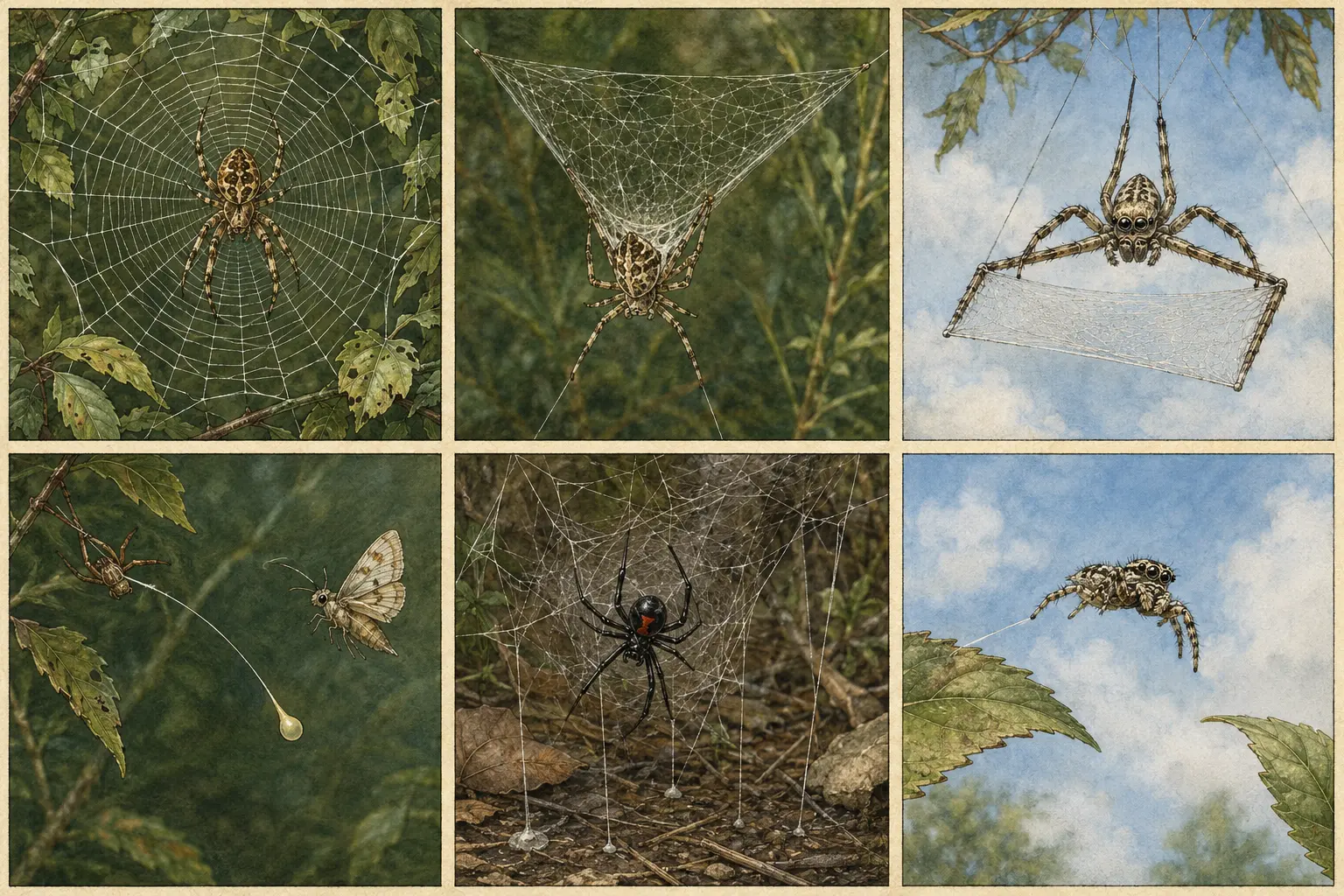
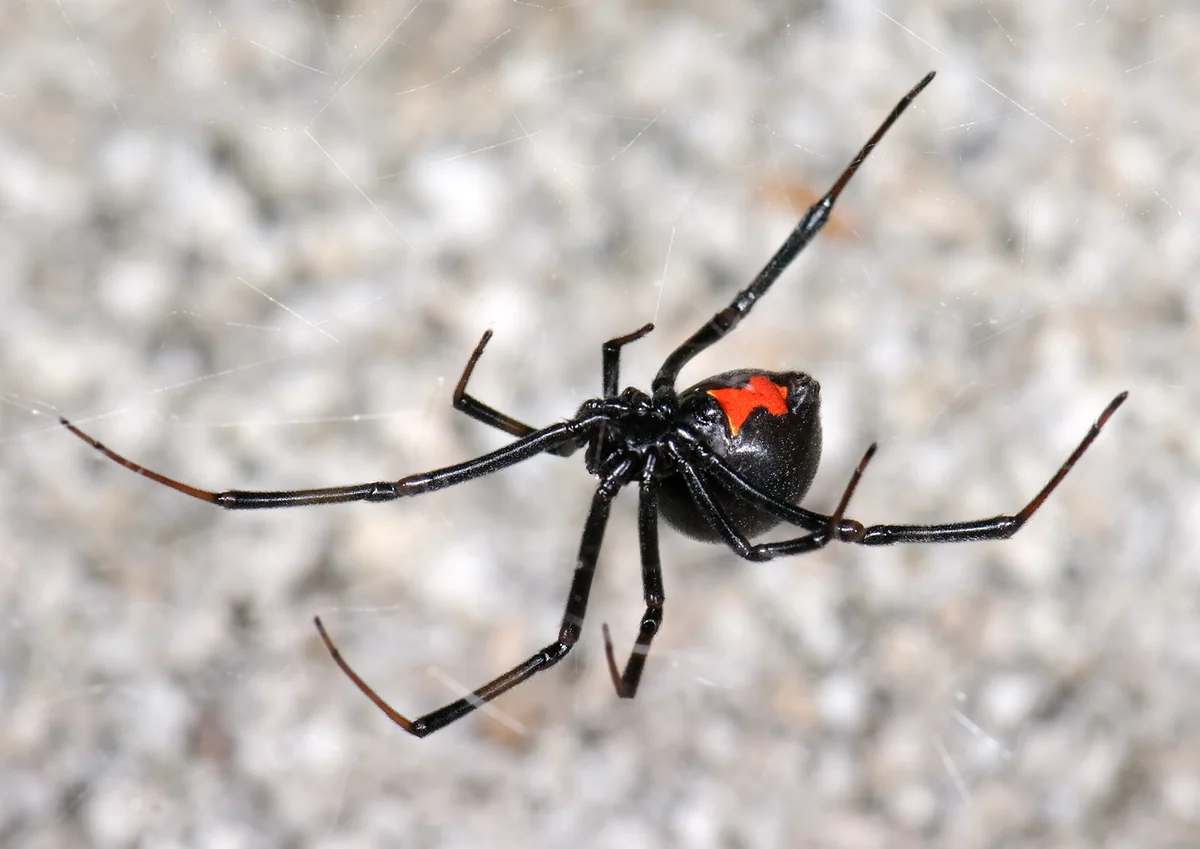
These explanatory illustrations show structures and mechanical ideas. The field photographs within the article record real spiders; each has its own species label, observation notes, photographer credit, and reuse license.
A web is more than its thread. Fiber chemistry sets what a line can do; arrangement decides how force travels, where energy is stored, and whether prey stays caught. Architecture turns silk from a material into a machine: intercept, deform, dissipate, retain—or, in non-trap uses, stabilize a jump or mark a path.
This page expands WebTug’s architecture chapter. It pairs each of the six roster strategies with a force-path reading and keeps the boundary between living structures and arcade visuals explicit.
Why this matters
Students often treat “sticky silk” as the whole explanation. Many capture systems fail or succeed because of geometry, pretension, anchor compliance, and which threads take the first hit. Reading webs as machines connects biology to introductory mechanics without pretending a browser demo is a full finite-element model.
01 — Orb: radial frame + capture spiral

Araneus trifolium in an orb web outlined by fog droplets in San Francisco.
Look closely: Trace one spoke outward from the spider, then follow a curved spiral strand across several spokes. The large visible beads are fog water; do not mistake them for a magnified photograph of microscopic capture-glue droplets.
The photographer combined multiple focus planes (focus stacking).
Photo: Brocken Inaglory · CC BY-SA 3.0 · Original / license record. Resized and converted to WebP; original composition retained.
Machine job: Intercept flying prey, deform, spread impact energy, and retain the insect long enough for the spider to arrive.
Force paths: Stiffer radial threads carry load away from the impact site. The more extensible capture spiral deforms locally and, with glue in a typical glue-spiral orb, helps prevent immediate escape. Impact energy can become fiber stretch and whole-web motion, then be dissipated through internal material losses and aerodynamic drag. Movement at the anchors also changes how the structure responds.
Teaching model on WebTug: After impact, a simplified damped oscillator stands in for a many-thread network (m·x″ + c·x′ + k·x = 0 in the Spider Physics Lab). Primary research pointer: Sensenig and colleagues on radial threads and energy absorption in orb webs.
Limitation: One effective spring and damper cannot encode humidity, glue droplets, exact impact location, or every silk type in the sheet.
02 — Slingshot triangle: preload, then release
Machine job: Store elastic energy before prey arrives; release it so spider and web move toward the target.
Force paths: The spider pulls an anchor line, raising tension in the triangular sheet. When prey contacts the web, the spider releases its hold and stored energy drives rapid motion. Geometry is sparse compared with a full orb; the animal’s active pretension is part of the machine.
Teaching model: Ideal spring energy Eₛ = ½ k (Δx)² as a visible preload metaphor. Primary research pointer: Han and colleagues on Hyptiotes elastic amplification.
Limitation: Real triangle webs use multiple lines and can release in stages; the demo shows one spring-like preload for clarity.
03 — Casting net: portable mesh, active throw

Deinopis spinosa holds a small capture net while foraging at night.
Look closely: Find the pale mesh in front of the body. It is a small portable capture surface, unlike the fixed orb in the comparison photograph. The original image is shown without enlarging its detail.
Photo: Jstaf13 · CC BY-SA 4.0 · Original / license record. Resized and converted to WebP; original composition retained.
Watch Cornell’s recorded forward and backward strikes alongside the net-caster profile.
Machine job: Take the capture surface to the prey instead of waiting on a fixed flight path.
Force paths: The spider holds a small stretchable net with the front legs, expands it, and casts it over the target. Force and area depend on how the mesh is stretched and aimed. Sensing and timing matter as much as passive dissipation.
Teaching model: Stretch force approximating F ≈ k·Δx, with area proportional to the square of scale only when the net stretches similarly in both dimensions. Primary research pointer: Stafstrom and Hebets on net-caster vision and prey capture; the University of Florida Deinopis spinosa account supplies natural-history context. The linear force relation is WebTug’s teaching approximation, not a constitutive law established by that vision study.
Limitation: The diagram isolates net stretch and active reach; it does not reproduce leg hydraulics or full 3-D strike dynamics.
04 — Bolas: line + adhesive mass + lure
Machine job: Deliver glue to a flying moth at close range with a flexible, flicked line.
Force paths: Tension and motion travel along a single working line to a concentrated adhesive droplet. Chemical mimicry brings the moth into range; the mechanical event is a targeted swing and contact, not a large intercepting sheet.
Teaching model: A damped pendulum baseline θ″ = −(g/L) sin θ − c·θ′. Here the displayed c is a damping rate, with units of inverse time, rather than the translational damping coefficient in the orb equation. Primary research pointers: Yeargan on Mastophora hunting and Diaz and colleagues on bolas behavior and bioadhesives. The pendulum equation is an instructional analogy; neither citation makes it a complete model of the animal’s strike.
Limitation: Pendulum math ignores extensible silk, glue deformation, moth flight, and active leg control.
05 — Gumfoot tangle: ground contact coupled to a 3-D spring
Machine job: Catch prey that contacts vertical sticky lines and haul or lift them into an irregular support web.
Force paths: Adhesive gumfoot lines under tension connect ground-level contact to upper scaffolding. When a line detaches or yields at the foot, stored energy in the three-dimensional tangle can pull prey upward. Attachment discs and local silk junctions matter; this is a volume machine, not a flat sheet.
Teaching model: A single vertical spring metaphor a = (k·Δx − m·g) / m representing energy stored across supporting cobweb structure, with upward acceleration positive. Primary research pointer: Sahni and colleagues on cobweb attachment and gumfoot-related mechanics; UC IPM provides habitat context.
Limitation: The gumfoot strand alone is not treated as the sole energy store; the upper tangle shares the spring-like role.
06 — Dragline: safety, signal, and jump control
Machine job: Arrest falls, transmit vibration, mark paths—or, in jumpers, help control pitch, deceleration, and energy dissipation during a leap.
Force paths: A major-ampullate line attached behind the body becomes taut under load. Tension redirects motion and dissipates energy once the line engages. This is usually not a prey-catching web; it is personal safety and control hardware.
Teaching model: After tautening, a linear spring–damper m·y″ = m·g − k·e − c·y′, where downward is positive and e is extension beyond the slack length. A physical tether cannot push: this approximation applies while tensile force remains positive; if the line goes slack, a separate slack phase is needed. Primary research pointer: Chen and colleagues on Hasarius jump-stabilizing draglines.
Limitation: Real dragline silk is nonlinear and depends on rate and humidity; the demo linearizes after engagement.
Comparing force paths at a glance
| Architecture | Who moves the structure? | Where energy is managed | Prey-catching? |
|---|---|---|---|
| Orb | Mostly passive until spider arrives | Shared across threads, especially load-bearing radii | Yes |
| Triangle | Spider preloads and releases | Stored elastic energy in sheet/anchor | Yes |
| Casting net | Spider throws the mesh | Stretch + strike timing | Yes |
| Bolas | Spider flicks the line | Line tension, swing, and adhesive contact | Yes (specialized) |
| Gumfoot tangle | Prey triggers line; web responds | 3-D scaffold + sticky feet | Yes |
| Dragline | Spider’s motion loads the line | Tension + damping in a tether | Usually no |
Architecture changes how force travels even when the proteins are cousins. That is the core WebTug teaching claim: material, structure, and machine are three stacked layers.
Ideal tether notes (and why Classic skips them)
A clean tethered-swing ideal begins with a taut massless line that constrains motion to an arc; release preserves instantaneous velocity into a projectile curve under gravity. The science-and-play guide develops the angular motion and tension formulas. In the ideal inextensible model, tension redirects the body without doing work along the constrained path. Real silk can stretch, dissipate energy, and go slack, so a spring-damper tether is a better next approximation than a rigid line.
WebTug deliberately uses neither swing model for play. Its one-button lift is an arcade teaching metaphor with transparent fixed accelerations. The architectures above live in the field guide and lab; the forest run keeps one readable control.
Trace a force path in a photograph
One contact, several routes to support
Start at an imagined prey contact on the orb photograph. Follow the local spiral to the nearby radii, then follow those spokes toward the frame and supporting vegetation. Some anchors are outside the crop; record them as unknown instead of assuming the visible edge is where the web ends.
Now look at the net-caster. Its front legs hold the mesh, and its body hangs from other support lines. A force on this net is coupled to an actively moving animal. That is a different boundary condition from a web fixed between plants.
Do not estimate spring stiffness from how straight a strand looks in a single picture. You would need scale, force, displacement, and an unloaded reference. The lab lets you vary a simplified stiffness deliberately; the photograph lets you inspect the architecture that the simplification leaves out.
How WebTug maps (and doesn’t)
Maps
- Six lab demonstrations mirror these six architectures with sources and limitations.
- Game profiles only change the silk-release drawing that hints at each machine.
- Homepage Chapter 05 language (“a web is more than its thread”) is the parent framing.
Doesn’t
- Playable WebTug is not an orb-impact simulator, slingshot simulator, or pendulum simulator.
- Forest trunks are score gates, not ecological anchors with compliance.
- Classic skins intentionally share gameplay rules and scoring. Separate science arcade games explore different silk mechanisms with their own controls.
Run the demos in the Spider Physics Lab. Compare the fixed arcade path in game physics and physics teaching vs WebTug.
Sources
- Sensenig et al. (2012): Spider orb webs rely on radial threads to absorb prey kinetic energy, Journal of the Royal Society Interface.
- Han et al. (2019): External power amplification drives prey capture in a spider web, PNAS.
- Stafstrom and Hebets (2016): Nocturnal foraging enhanced by enlarged secondary eyes in a net-casting spider, Biology Letters; University of Florida species account.
- Yeargan (1988): Ecology of a bolas spider, Mastophora hutchinsoni, Oecologia; Diaz et al. (2022): Behavior and Bioadhesives, Insects.
- Sahni et al. (2012): Cobweb-weaving spiders produce different attachment discs for locomotion and prey capture, Nature Communications.
- Chen et al. (2013): More than a safety line: jump-stabilizing silk of salticids, Journal of the Royal Society Interface.
- OpenStax University Physics: pendulums and damped harmonic motion — ideal-model background.
- Physics teaching versus the WebTug game and Spider Physics Lab evidence table — the site’s model choices and limitations.