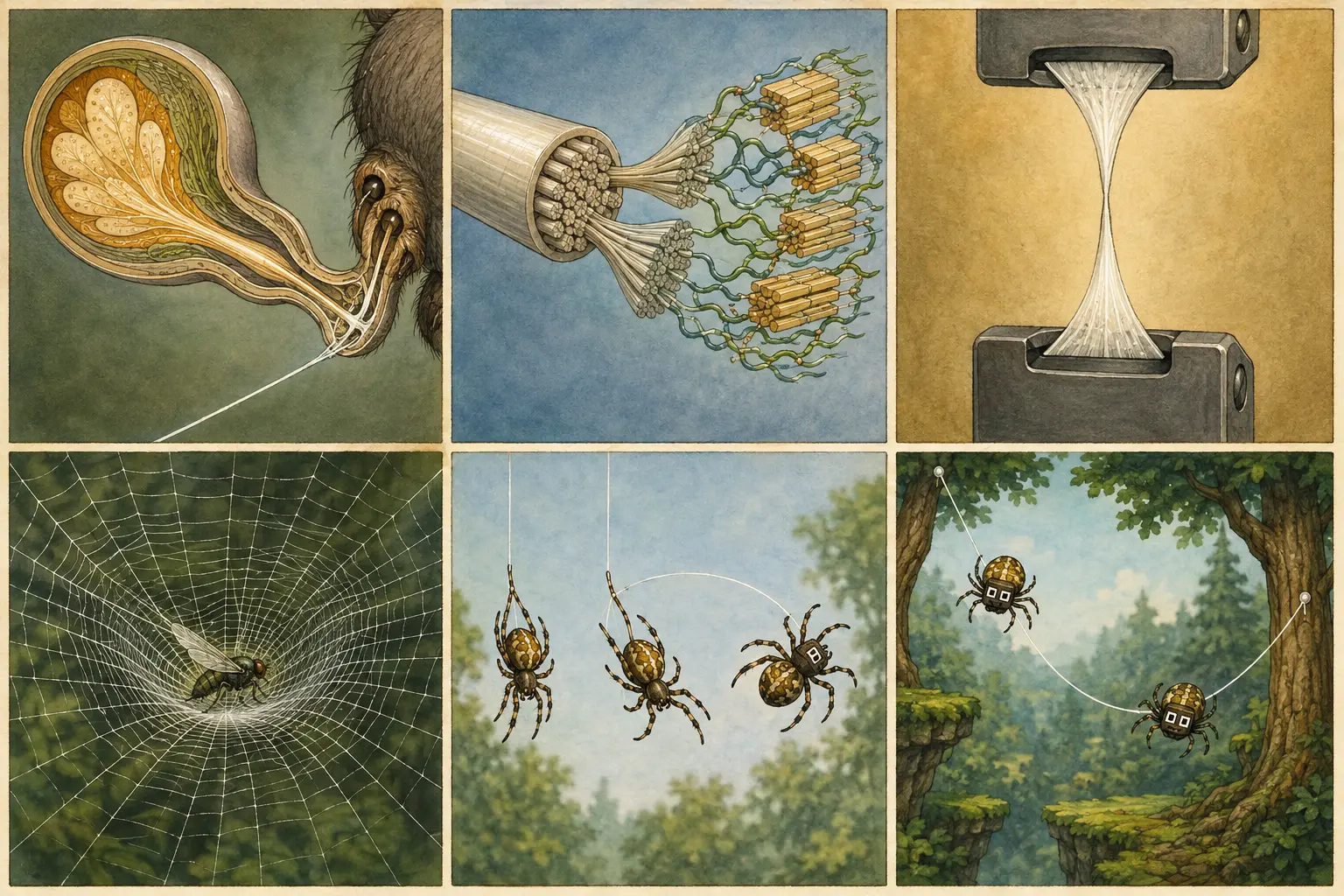
These explanatory illustrations show structures and mechanical ideas. The field photographs within the article record real spiders; each has its own species label, observation notes, photographer credit, and reuse license.
WebTug Classic sits alongside a field guide and a science arcade. The science pages talk about kinetic energy, stress, strain, elastic storage, and tethered motion. The Classic spider uses none of those equations as its control law. It uses two fixed arcade accelerations, two speed caps, and one shared rule set for every profile during active play.
I designed that split on purpose. Real silk strategies are unequal. Fair high scores should not be. This article states both sides clearly so teachers, players, and reviewers can see where analogy ends.
Why this matters
If Classic quietly claimed to simulate orb impact or triangle preload, it would be misleading. The science pages also need to name the arcade constants. Naming both—classroom equations and pixel accelerations—keeps the educational promise honest: learn the vocabulary of capture mechanics; practice a readable one-button path; inspect the lab when you want the silk machines to differ.
Classroom equations the site actually teaches

Araneus trifolium in an orb web outlined by fog droplets in San Francisco.
Look closely: Trace one spoke outward from the spider, then follow a curved spiral strand across several spokes. The large visible beads are fog water; do not mistake them for a magnified photograph of microscopic capture-glue droplets.
The photographer combined multiple focus planes (focus stacking).
Photo: Brocken Inaglory · CC BY-SA 3.0 · Original / license record. Resized and converted to WebP; original composition retained.

Deinopis spinosa holds a small capture net while foraging at night.
Look closely: Find the pale mesh in front of the body. It is a small portable capture surface, unlike the fixed orb in the comparison photograph. The original image is shown without enlarging its detail.
Photo: Jstaf13 · CC BY-SA 4.0 · Original / license record. Resized and converted to WebP; original composition retained.
Incoming motion — kinetic energy
Eₖ = ½ m v²
An insect’s kinetic energy rises with mass and with the square of speed. Doubling speed gives four times the kinetic energy. A capture structure must redirect or dissipate that energy without letting prey rebound out or fibers fail. Outcome depends on material response, pretension, damping, geometry, anchor compliance, prey size, impact location, and how the spider modifies the web.
Engineering stress and strain
σ = F / A₀ — engineering stress divides force by the fiber’s initial cross-sectional area.
ε = ΔL / L₀ — engineering strain compares length change with initial gauge length.
These definitions let you talk about tensile tests without confusing absolute force with stress, or stretch distance with strain. Toughness—energy absorbed before fracture—needs the whole stress–strain curve, not only peak stress. See the silk materials article for the silk-versus-steel footnote table.
Ideal linear-spring energy
Eₛ = ½ k x²
A simplified linear spring stores more energy as effective stiffness k or displacement x increases. Real silk is nonlinear and dissipative. Still, spring energy is the right first language for triangle-weaver preload and for “stored elastic energy” talk in the lab’s slingshot mode.
Ideal tethered swing (literacy, not Classic’s control law)
A taut line attached above a moving body constrains motion to an arc. Gravity changes speed; the line supplies inward force; release preserves current velocity so the path becomes a projectile curve. Ideal assumptions: point mass, fixed pivot, massless inextensible line, constant gravity, no air drag, line remains taut.
With angle θ from straight down and line length L:
- Angular motion: θ̈ = −(g/L) sin θ
- Line tension while taut: T = m (v²/L + g cos θ)
- After release: r⃗(t) = r⃗ᵣ + v⃗ᵣ t + ½ g⃗ t²
In the release equation, time starts at release and g⃗ points downward. If the tension expression would become negative, the line goes slack and the taut-line assumptions no longer apply.
Real spider silk can stretch, dissipate energy, and go slack. A spring-damper tether is a better next approximation than a rigid line. WebTug Classic uses neither model.
What WebTug’s arcade model actually is
From the site’s game-physics page, the vertical path during active play is defined by four values. Canvas coordinates increase downward, so negative acceleration changes velocity upward; a falling spider first slows before it starts to rise.
| Constant | Value | Role |
|---|---|---|
| Held acceleration | −1,150 px/s² | Fixed upward arcade lift while holding |
| Released acceleration | +920 px/s² | Fixed downward arcade pull while released |
| Upward speed cap | −370 px/s | Clamp on upward velocity |
| Downward speed cap | +440 px/s | Clamp on downward velocity |
Shared timing detail: visible web travel is about 0.12 s to full reach. Upward acceleration begins immediately when a hold starts; the strand animation does not gate the force. That matters for micro-taps: a short press still changes velocity even if the line never finishes extending on screen.
Each animation step updates velocity, clamps it, then updates position. The forest moves left at the same time, creating forward travel. Worked numerical examples (0.07 s tap from rest; 0.55 s fall without lift) live on game physics and in the timing tutorial. Those worked displacements are continuous-time approximations; the game advances with discrete steps, so sampled trajectories can differ slightly. After a collision, a separate crash animation runs; the table describes controllable play.
Fairness rule
Selecting Shamrock orb-weaver, triangle weaver, net-caster, bolas spider, western black widow, Adanson’s house jumper, or WebTug Classic changes silhouette, palette, markings, and released-silk drawing only. Weight, accelerations, speed caps, collision box, controls, score rules, body motion, and eyes remain identical.
That boundary is deliberate. Real spiders do not move through forests using Classic’s lift equation, and the six real silk strategies would not create equal acceleration. One fixed model keeps Classic learnable and its scores comparable. The separate science arcade challenges each state their own controls and teaching assumptions. The Spider Physics Lab is where real strategies receive separate simplified demonstrations and source links.
Side-by-side: teaching idea vs playable rule
| Topic | Science / lab teaching | WebTug Classic |
|---|---|---|
| Orb impact | Damped elastic network after insect kinetic energy arrives | Same fixed accelerations as every Classic skin |
| Triangle preload | Store and release spring-like energy | Triangle is a silk drawing only |
| Casting net | Active stretch and throw | Expanding-net visual only |
| Bolas | Pendulum + glue contact baseline | Swinging-bolas visual only |
| Gumfoot | Tensioned ground lines + 3-D scaffold | Gumfoot-tangle visual only |
| Dragline jump | Spring–damper after line tautens | Double dragline visual only |
| Tethered swing formulas | Mechanics literacy | Not used as control law |
| Hold input | Analogy to attaching / loading silk | Immediate fixed upward acceleration |
What Classic’s fixed accelerations deliberately do not model
- Nonlinear silk constitutive behavior
- Humidity-dependent glue or fiber response
- Multi-thread load sharing and anchor compliance
- Species differences in mass, strength, or hunting power
- True pendulum dynamics or projectile release from a taut biological line
- Wind, rain, or ecological prey traffic
- Life stage, molt state, or ballooning
The forest openings are a constrained random path with fairness limits (see obstacle fairness), not a biomechanics sandbox. Medals and scoring are run-length incentives (scoring and medals), not scientific fitness scores.
How to use both halves in a classroom or self-study path
- Play a short run on Play to feel hold-versus-release timing.
- Read game physics so the accelerations are numbers, not mysteries.
- Open the Spider Physics Lab and switch among orb, slingshot, net, bolas, gumfoot, and dragline modes—watch the equation and source change.
- Return to the field-guide articles on silk materials and architectures when you need vocabulary for strength, toughness, and force paths.
- Keep the sentence: web animations teach by analogy; they do not change the forces.
Worked example: doubling impact speed
The same mass, four times the energy
For an illustrative 1 milligram object moving at 1 m/s, kinetic energy is ½ × 0.000001 kg × (1 m/s)² = 0.5 microjoules. At 2 m/s, the same object carries 2 microjoules. Doubling mass at the original speed would instead give 1 microjoule.
This calculation describes incoming motion. It does not predict whether a real insect stays caught: glue contact, web deformation, escape behavior, and anchor motion still matter. Nor can these values be inserted into WebTug’s pixel accelerations without a separate model connecting the units.
In the orb-impact demonstration, hold the stiffness and energy-loss controls steady and change only the impact-energy control. Compare the motion, then reverse the experiment: keep impact energy steady and vary stiffness. Changing one input at a time helps explain which assumption caused the visible difference.
How WebTug maps (and doesn’t)
Maps
- Homepage Chapter 06 equations appear here as teaching literacy.
- The Classic game-physics page constants appear here as the real control law during active play.
- Creator note: gamify a materials-and-biomechanics topic without pretending arcade movement is biological simulation.
Doesn’t
- This article does not add new physics constants beyond what the site already publishes.
- Lab slider values are comparative demos; they do not feed the playable game.
- Analogies are not hidden simulations.
Sources
- WebTug game physics — arcade constants and worked examples, checked against the active-play code for this publication.
- WebTug Spider Physics Lab — six teaching models and primary sources.
- WebTug game physics and the interactive silk-use models.
- OpenStax University Physics: kinetic energy, stress and strain, potential energy, and pendulums.
- Gosline et al. (1999): The mechanical design of spider silks — mechanical definitions and the material comparison.
- Sensenig et al. (2012), Han et al. (2019), Stafstrom and Hebets (2016), Sahni et al. (2012), and Chen et al. (2013) — the biological strategies behind the lab analogies.
- Timing tutorial — captioned path reading.