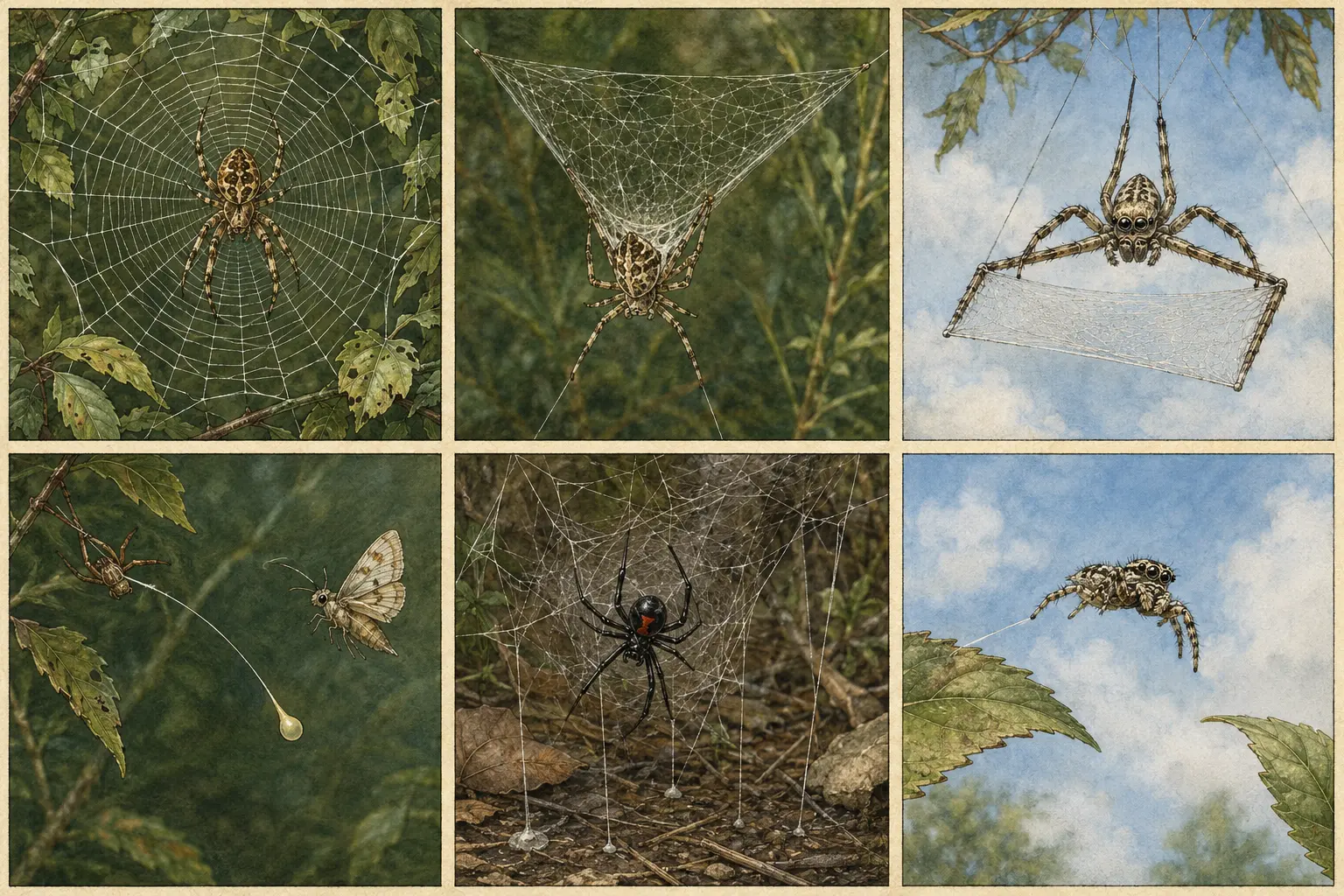
These explanatory illustrations show structures and mechanical ideas. The field photographs within the article record real spiders; each has its own species label, observation notes, photographer credit, and reuse license.
These six species inspire both WebTug Classic character skins and the six separate science arcade games. In Classic, choosing a skin changes the appearance and silk animation while keeping movement, hitbox, and scoring identical. Each science arcade game has its own controls and simplified physics, explained on its game page.
Read these profiles as strategy notes with scientific names—not as a complete range map, and not as a medical or identification manual.
Why this matters
“Spider silk” is not one behavior. An orb that dissipates impact, a triangle that stores elastic energy, a hand-held net, a swinging bolas, a gumfoot tangle, and a jump-stabilizing dragline are different machines made from related materials. Separating real silk use from Classic skin animation keeps the educational claim honest: the animations teach by analogy; Classic skin animations do not change Classic’s forces. The six science games explore the mechanisms with distinct simplified rules.
01 — Shamrock orb-weaver (Araneus trifolium)

Araneus trifolium, photographed in the Montréal region.
Look closely: Look for the large abdomen behind the smaller prosoma and the legs meeting several strands. Those contact points connect the spider to its web. Body color alone is insufficient to identify a species.
Photo: Smidon33 · CC BY-SA 3.0 · Original / license record. Resized and converted to WebP; original composition retained.
Where it lives (short note): Recorded in Alaska, Canada, and the United States, where a vertical orb in vegetation can span an insect flight path.
Real silk use: An orb’s radial threads transmit and absorb impact; its sticky spiral helps keep intercepted prey in the web. Load-bearing radii and a deformable capture spiral work together: energy spreads through the structure instead of staying at one contact point. Sensenig and colleagues’ work on orb-web impact mechanics is the site’s primary research pointer for this strategy. Their experiments address orb-web mechanics across the species studied; this profile uses that strategy-level evidence without claiming a separate mechanical measurement for every game species.
Classic skin animation: Radial orb fan.
Boundary: The Classic skin’s orb drawing is a release cue. It does not simulate multi-thread damping, humidity-dependent glue, or impact location effects. Those ideas belong in the Spider Physics Lab’s orb-impact mode.
02 — Triangle weaver (Hyptiotes cavatus)

Hyptiotes cavatus at Julie Metz Wetlands in Woodbridge, Virginia.
Look closely: The close view reveals how the spider grips individual lines. The entire triangular web is outside this frame; use the accompanying release footage to see the moving structure.
Photo: Judy Gallagher · CC BY 2.0 · Original / license record. Resized and converted to WebP; original composition retained.
Where it lives (short note): Recorded in Canada and the United States, especially wooded eastern regions, with a triangular web fixed to supports.
Real silk use: The spider pulls on a separate anchor line to preload its triangular web. Releasing its hold lets stored elastic energy propel both spider and web toward prey. This is elastic amplification in a biological slingshot—not passive waiting alone. Han and colleagues’ PNAS study is the site’s primary pointer for that mechanism.
Classic skin animation: Tensioned triangle.
Boundary: The lab’s slingshot demonstration uses a simplified spring-energy teaching model. A living Hyptiotes web contains multiple lines and can release in repeated stages.
03 — Ogre-faced net-caster (Deinopis spinosa)

Deinopis spinosa wrapping prey in silk.
Look closely: The long body and spread legs have very different proportions from an orb-weaver. The photographer records prey wrapping here, which is a later stage than casting the capture net.
Photo: Alex Abair · CC BY 4.0 · Original / license record. Resized and converted to WebP; original composition retained.
Where it lives (short note): Recorded in the southeastern United States, Jamaica, St. Vincent, and Venezuela; it is a nocturnal hunter.
Real silk use: A small stretchable capture net is held with the front three pairs of legs and cast over prey rather than left as a fixed aerial trap. Portability and timing replace a permanent flight-path sheet. The University of Florida’s species account and Stafstrom and Hebets on net-caster vision and prey capture provide the natural-history and behavior evidence. The net uses dry, woolly cribellate silk; it is not the wet glue-coated spiral of a typical garden orb. Mature males stop net casting and search for mates.
Classic skin animation: Expanding capture net.
Boundary: WebTug Classic keeps the original arcade eyes on every skin, including this one. The casting-net lab mode isolates stretch and reach for teaching; it does not reproduce leg hydraulics or full three-dimensional strike control.
04 — Bolas spider (Mastophora hutchinsoni)
.jpg)
A female Mastophora hutchinsoni photographed in Georgia, United States.
Look closely: This portrait shows the compact resting posture and patterned abdomen. No hunting bolas is visible. The hunting film in the field profile demonstrates the separate line-and-droplet strategy.
Photo: Christina Butler · CC BY 2.0 · Original / license record. Resized and converted to WebP; original composition retained.
Where it lives (short note): Vegetation across much of eastern North America, where subadult and adult females hunt moths after dark.
Real silk use: An adhesive droplet hangs from a silk line. Adult females mimic female-moth sex pheromones, then flick the bolas toward approaching male moths. The system combines a flexible line, a moving adhesive mass, and chemical mimicry. Yeargan’s study of subadult and adult female hunting and Diaz and colleagues’ work on behavior and bioadhesives explain the hunting sequence.
Classic skin animation: Swinging sticky bolas.
Boundary: A pendulum equation is only an instructional baseline in the lab. Real captures include active leg motion, extensible silk, glue deformation, moth flight, and contact dynamics.
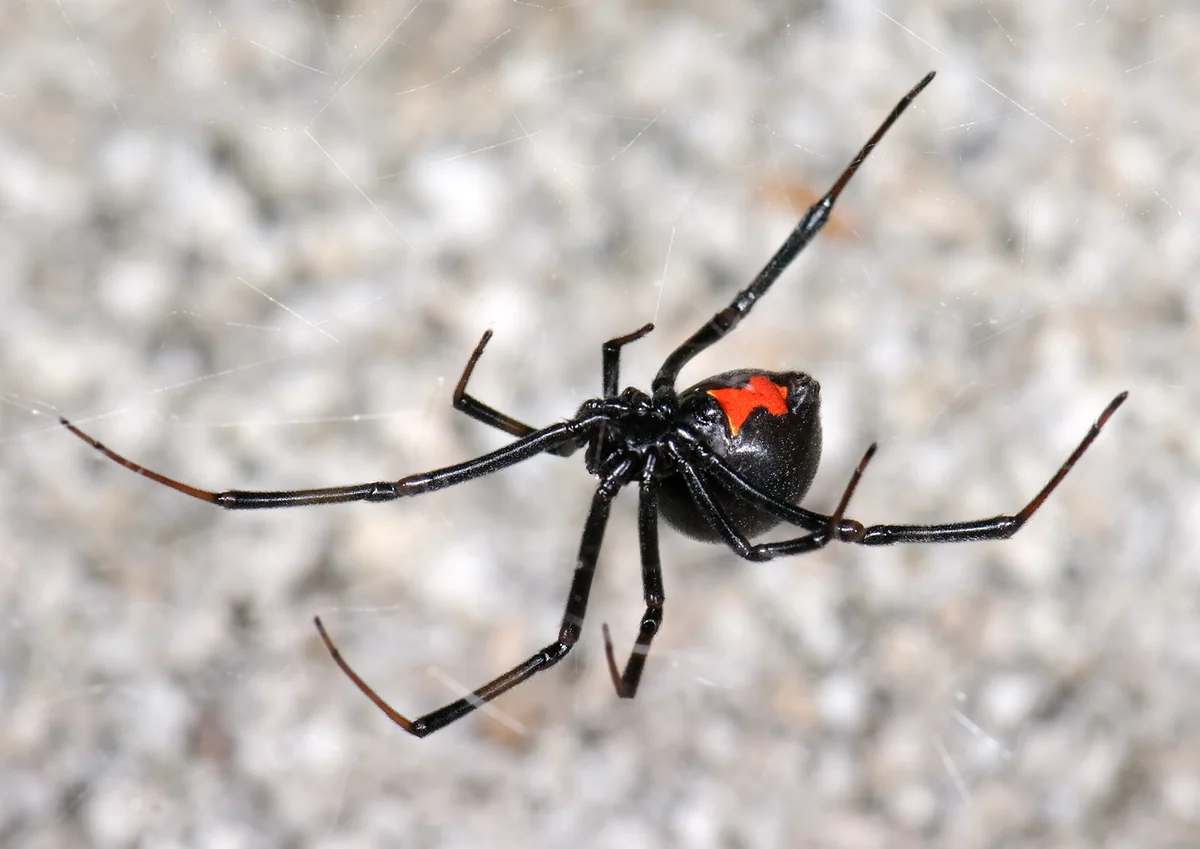
05 — Western black widow (Latrodectus hesperus)
.jpg)
Latrodectus hesperus in its web at night in desert-wash habitat.
Look closely: The view is from underneath: the hourglass is on the underside of the abdomen. Trace the irregular threads around the legs. The photographed marking is not enough to identify an unfamiliar spider or assess a health concern.
Photo: Marshal Hedin · CC BY 2.0 · Original / license record. Resized and converted to WebP; original composition retained.
Where it lives (short note): Native to western North America from southwestern Canada through the western United States into Mexico, often in protected recesses. The catalog also records introductions outside this native range.
Real silk use: An irregular tangle includes adhesive gumfoot lines under tension; contact can break a line free and pull prey upward. Upper scaffolding stores and redirects energy; ground-contacting sticky lines couple prey contact to that three-dimensional spring-like support. UC IPM’s widow habitat account and Sahni and colleagues on cobweb attachment mechanics are the site’s linked sources.
Classic skin animation: Gumfoot tangle.
Boundary: Stylized red-and-black markings in a game are not a bite-identification tool. Most spiders use venom to subdue prey; medical risk is a separate clinical question. WebTug’s spider-lab page states that educational venom context and links regulated antivenin information for clinician use. For any health-related concern, contact your doctor. Call 911 for an emergency. Do not use these profiles to identify a spider, diagnose a bite, or choose treatment.
06 — Adanson’s house jumper (Hasarius adansoni)

A male Hasarius adansoni photographed in São Paulo, Brazil.
Look closely: The two main body regions are visible from above. This resting photograph does not show a taut dragline, so it cannot establish how a line affects a jump; that requires motion measurements.
Photo: Leonardo Ré-Jorge · CC BY-SA 4.0 · Original / license record. Resized and converted to WebP; original composition retained.
Where it lives (short note): Recorded across Africa and the Middle East and introduced widely through the Americas, Europe, Asia, Australia, and Pacific islands—often in and around buildings.
Real silk use: It hunts by sight rather than with a prey-catching web. During a jump, its dragline helps control pitch, deceleration, and energy dissipation. Chen and colleagues on jump-stabilizing draglines provide the primary research evidence.
Classic skin animation: Double safety dragline.
Boundary: Classic’s dragline drawing is a visual cue that leaves Classic’s movement unchanged. In the separate Silk Landing game, the airborne silk brake reduces forward speed and body rotation. The lab’s dragline mode uses a simplified spring–damper after the line becomes taut; real major-ampullate silk is nonlinear and depends on rate and humidity.
How WebTug Classic maps (and doesn’t)
Maps
- Silhouette, palette, markings, and released-silk drawing change with profile.
- Spider Physics Lab modes match these six silk uses with teaching equations and primary sources.
- The lab explains why Classic scores stay fair across character profiles.
Doesn’t
- Profile never changes held acceleration (−1,150 px/s²), released acceleration (+920 px/s²), speed caps, web-travel time (0.12 s), weight, collision box, eyes, or body-motion clock.
- Classic skins never give hidden gameplay advantages. Each science arcade game explains its own rules.
- Field notes are not complete biogeography.
Play WebTug Classic or choose a separate challenge in the science arcade. Compare real strategies in the Spider Physics Lab. Read Classic’s fixed equation in game physics.
Sources
- World Spider Catalog species records: Araneus trifolium, Hyptiotes cavatus, Deinopis spinosa, Mastophora hutchinsoni, Latrodectus hesperus, and Hasarius adansoni.
- Sensenig et al. (2012): Spider orb webs rely on radial threads to absorb prey kinetic energy, Journal of the Royal Society Interface.
- Han et al. (2019): External power amplification drives prey capture in a spider web, PNAS.
- Stafstrom and Hebets (2016): Nocturnal foraging enhanced by enlarged secondary eyes in a net-casting spider, Biology Letters; University of Florida species account.
- Yeargan (1988): Ecology of a bolas spider, Mastophora hutchinsoni, Oecologia; Diaz and Long (2022): Behavior and Bioadhesives: How Bolas Spiders, Mastophora hutchinsoni, Catch Moths, Insects.
- Sahni et al. (2012): Cobweb-weaving spiders produce different attachment discs for locomotion and prey capture, Nature Communications; UC IPM widow account.
- Chen et al. (2013): More than a safety line: jump-stabilizing silk of salticids, Journal of the Royal Society Interface.
- WebTug Spider Physics Lab evidence table.