CHOOSE YOUR WEB
One familiar spider style. Six different ways to use silk. All playable with touch or keyboard, with no ads during play.
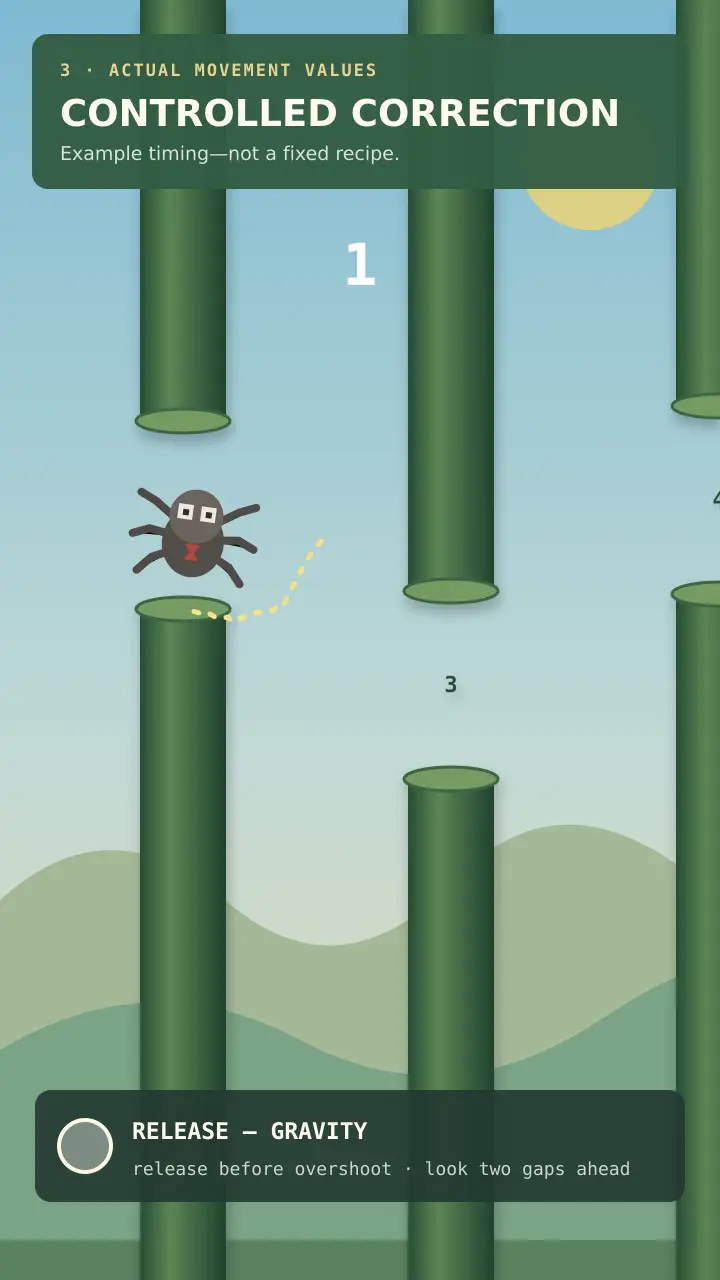
WebTug Classic
Hold. Release. Thread the forest. The original game, exactly as you know it.
Play ClassicOrb Guardian
Catch the falling prey. Let the web give before it snaps.
Play nowTriangle Launch
Charge the triangle. Release into the moving target.
Play nowNight Net
Track the runner. Cast where it will be, not where it was.
Play nowBolas Beat
One sticky droplet. One well-timed strike.
Play nowTrapline Rush
Arm a lane. Let a ground-level trip become an upward spring.
Play nowSilk Landing
Pull back to aim. Land on branches at changing heights.
Play now
BEYOND THE WEB · BUILD & TEST
River Shelter
Six pieces. Ten silk bonds. Can your underwater case hold against the current?
Build a shelter →FROM WEBTUG’S OWN GAME MODEL
WHAT WE TESTED, AND WHAT WE FOUND
How much can a constrained course still vary? Why can a small input delay change a run? These two WebTug investigations publish their measurements, methods, and limits so you can check the answers yourself.
Large moves remain in the constrained course.
- Generated transitions
- 20,000
- Large moves
- 36.675%
7,335 moves exceeded 65% of the configured maximum. The protected continuation rule applied 2,029 times, with 0 violations in this seeded portrait test.
This checks the course generator, not whether every player can recover from every position.
Read the test, method, and raw dataThe same height can hide very different outcomes.
- Immediate correction
- 2 gaps
- Wait 0.100 seconds
- 0 gaps
Both scripted runs start at the same height and downward speed. The early correction clears both openings; the delayed correction collides at 0.350 seconds. Inspect each frame to see the difference develop.
This is one selected simulation using Classic’s rules, not a human trial or a universal reaction-time limit.
Inspect both replays and the input timingsThese results describe WebTug Classic. For real spiders and silk, explore the source-linked science guides; the science-to-game comparison explains where the models differ.
ONE MINUTE TO UNDERSTAND THE SCIENCE
Watch an original visual explanation, make a prediction, then try the matching experiment. Explore all 14 science minutes →
Double speed, quadruple energy
Calculate an illustrative insect-sized impact, then change one control in the orb model to test a prediction.
Jump to a chapter
Original WebTug explanation with animated teaching diagrams and credited still photographs. On-screen text carries the lesson; there is no audio narration.
Diagrams simplify the science. Animation timing and diagram dimensions are illustrative, not measurements of live spiders.
Run the orb-impact comparison →Read the full transcript
- What changes when prey moves faster?
Incoming motion carries kinetic energy: Eₖ = ½mv². Keep mass fixed and notice that speed is squared.
- Begin with one milligram
Use an illustrative mass of 1 mg: 0.000001 kg. At 1 m/s, its kinetic energy is 0.5 microjoules.
- Now double the speed
At 2 m/s, the same 1 mg object carries 2 microjoules. Twice the speed gives four times the kinetic energy.
- The web must respond
Silk deformation can store some incoming energy and dissipate some. Geometry and load sharing also shape how a web responds.
- Energy alone cannot predict capture
Glue contact, impact position, anchors, and the animal's behavior still matter. This calculation is an example, not a measured capture result.
- Test one change in the lab
Keep stiffness and energy loss fixed. Increase only impact energy, predict the change, and compare the orb model's motion.
Scientific sources and media credits
- OpenStax University Physics: Kinetic energy
- Gosline et al. (1999): Silk mechanics and energy absorption
- WebTug: Worked impact example
Araneus trifolium — Araneus trifolium and its web with fog droplets.jpg by Brocken Inaglory, CC BY-SA 3.0. Photograph fitted within the video without changing its composition; labels and animated diagrams added around it. The photographer combined multiple focus planes (focus stacking).
Script, diagrams, animation, and editing: WebTug, September 27, 2026. This video adaptation is available under CC BY-SA 4.0; individual photographs retain their credited licenses.
TAKE YOUR CURIOSITY FURTHER
PLAY. NOTICE. UNDERSTAND.
A mistimed cast, a bouncing web, or a controlled landing gives you something to investigate. Each challenge explains its mechanism and its limits. The field guide, real footage, and Physics Lab let you keep exploring beyond the score.