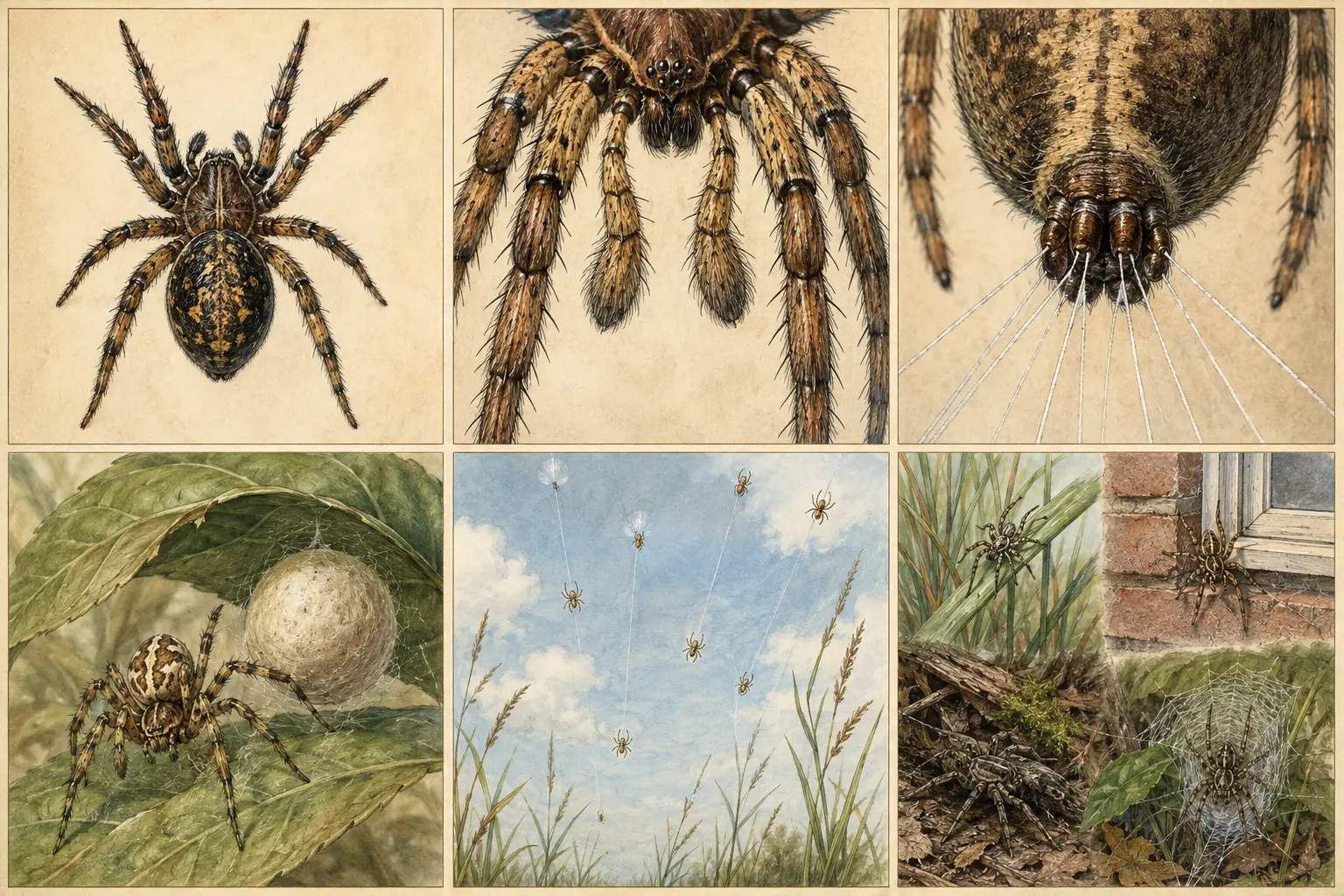
These explanatory illustrations show structures and mechanical ideas. The field photographs within the article record real spiders; each has its own species label, observation notes, photographer credit, and reuse license.
Spiders are arachnids, not insects. That distinction matters for how you read any educational page about silk, webs, or games inspired by them. Insects typically have three body regions, six legs, and antennae; spiders have two main body regions, eight walking legs, no antennae, and no wings. They also produce specialized protein fibers—silk—from glands that open through spinnerets on the abdomen.
I built WebTug as a timing game and a materials-and-biomechanics field guide. This focused biology primer explains what a spider’s body is for, how it senses the world, what it eats, and why silk is useful even when there is no capture web at all.
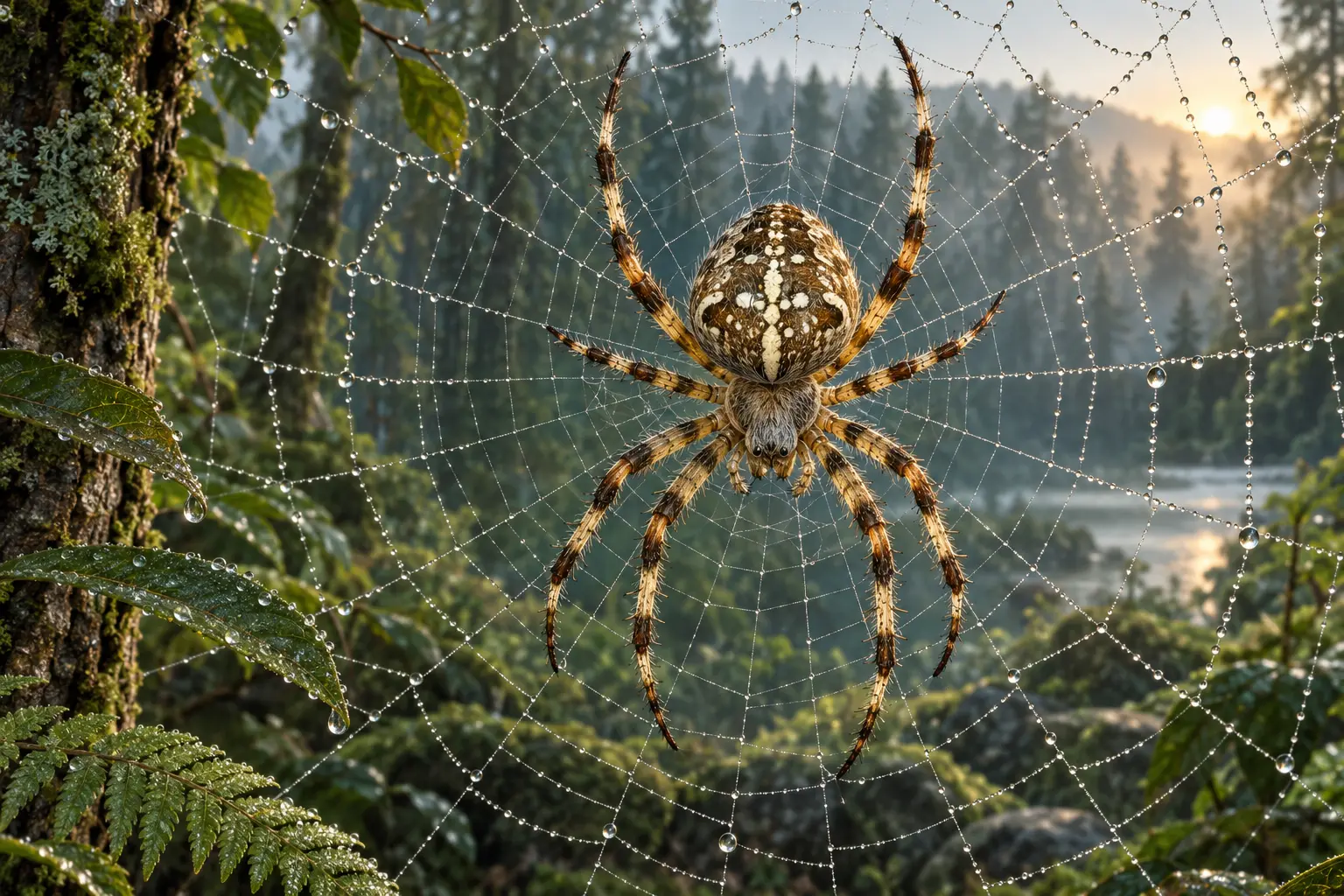
This high-resolution editorial illustration provides visual context, not a species-identification key. Use the credited field photographs below to inspect recorded specimens.
Why this matters
If you only meet spiders through cartoons or arcade silhouettes, it is easy to treat “web” as the whole story. Real spiders are sensing machines first. Legs read vibration and strain; eyes and pedipalps help with prey and courtship; silk is a toolkit with many jobs. Understanding that toolkit makes the six WebTug species profiles readable as strategies rather than costumes—and it keeps the game’s fictional lift model from being mistaken for biology.
Two body regions, eight legs, many silks

Araneus trifolium, photographed in the Montréal region.
Look closely: Look for the large abdomen behind the smaller prosoma and the legs meeting several strands. Those contact points connect the spider to its web. Body color alone is insufficient to identify a species.
Photo: Smidon33 · CC BY-SA 3.0 · Original / license record. Resized and converted to WebP; original composition retained.

A male Hasarius adansoni photographed in São Paulo, Brazil.
Look closely: The two main body regions are visible from above. This resting photograph does not show a taut dragline, so it cannot establish how a line affects a jump; that requires motion measurements.
Photo: Leonardo Ré-Jorge · CC BY-SA 4.0 · Original / license record. Resized and converted to WebP; original composition retained.
A spider’s body divides into two regions joined by a narrow pedicel.
Prosoma (cephalothorax)
The prosoma, also called the cephalothorax, carries the eyes, mouthparts, pedipalps, and the eight walking legs. It is the locomotion and sensing platform. Because the outer cuticle is rigid, growth happens through molting rather than continuous expansion of a soft skin.
Abdomen
The abdomen houses many internal organs and the silk-producing glands. Usually near its rear, movable spinnerets bring together many microscopic silk outlets. That arrangement lets a spider place, combine, and switch fiber types for different tasks—dragline, attachment disc, wrapping silk, egg-sac casing, and more.
Quick field facts that stay useful:
- 8 walking legs
- 2 main body regions
- 0 antennae or wings
- many specialized silk systems across spider groups
These are identification and anatomy ideas, not gameplay stats. WebTug’s playable spider keeps one hitbox and one movement model for every profile so scores stay comparable.
Built for sensing and handling
Spiders live in a vibration-rich world. Fine hairs on the legs respond to air movement and contact. Slit-like strain sensors help a spider read deformation through a surface or through a web. That sensing is part of why capture structures work: the web is not only a trap; it is also a signal network that reports where and how something hit.
Pedipalps sit ahead of the walking legs. They help manipulate food and, in adult males, play a reproductive role. Mouthparts and venom glands (when present) help subdue prey after capture. “Has venom” is not the same claim as “poses a major medical risk to people.” Risk depends on species, circumstances, and medical context that a game site cannot evaluate. WebTug’s stylized profiles are never safety-identification tools. For any health-related concern, contact your doctor. Call 911 for an emergency.
For dorsal anatomy orientation, the American Museum of Natural History’s arthropod morphology guide remains a clear classroom-style reference. The Australian Museum’s spider learning pages are a strong general overview of biology and diversity.
Diet: mostly predators, with many hunting styles
Many spiders capture insects and other arthropods. That does not mean every spider waits in an orb. Hunting style tracks ecology and silk use:
- Orb-weavers intercept flying prey on a radial frame and capture spiral.
- Triangle weavers preload a triangular web and release stored elastic energy.
- Net-casters hold a stretchable mesh and throw it over prey.
- Bolas spiders target moths with an adhesive droplet and chemical mimicry.
- Widow spiders use irregular tangles that include tensioned gumfoot lines.
- Jumping spiders stalk by sight and often use a dragline for control rather than a prey-catching web.
The shared theme is predation and energy management, not a single silhouette. Silk can be a fixed machine, a portable tool, a chemical lure platform, or a safety line during an active chase. The six silk strategies guide connects each example to its species account and research.
Silk uses far beyond a web

Spinneret detail on a female Argiope bruennichi photographed near Pisa, Italy.
Look closely: Locate the small spinneret structures where the line leaves the abdomen. A photograph can show the outlet and thread, but it cannot identify the protein composition or breaking strength by appearance.
Photo: Lucarelli · CC BY-SA 3.0 · Original / license record. Resized and converted to WebP; original composition retained.

A wasp spider (Argiope bruennichi) releases many silk threads while wrapping prey.
Look closely: Many fine strands emerge together near the rear of the abdomen. This is an external view of silk use; the glands and changing chemistry inside the body are not visible. This wasp spider is an additional biology example.
Photo: GeraldH51 · CC BY-SA 4.0 · Original / license record. Resized and converted to WebP; original composition retained.
Calling silk “web material” undersells it. Across spiders, silk appears in jobs that have little to do with a classic hanging trap:
- Draglines for safety, route cues, and vibration transmission
- Shelters and retreats
- Egg sacs that buffer and conceal developing young
- Prey wrapping during immobilization
- Dispersal (ballooning lines that interact with moving air and electric fields)
- Mating signals and sperm webs
- Attachment discs that cement a line to bark, leaves, stone, or another thread
- Capture structures of many geometries—orb, triangle, net, bolas, gumfoot tangle, and more
Material specialization supports those jobs. Major-ampullate silk often emphasizes strength with useful extensibility for frames and draglines; flagelliform fibers plus aggregate glue form the sticky capture spirals of many orb-weavers; aciniform silk wraps prey; tubuliform silk contributes to egg-sac casing; pyriform secretions form attachment discs. Not every spider has every gland system: this is a comparison across groups. The silk-materials guide expands that comparison with the usual caveats about measurement conditions.
What spiders are not
A few common mix-ups are worth closing early:
- Spiders are not insects.
- Not every spider builds a prey-catching web.
- A game character with eight legs is still not a taxonomic claim about that species’ exact proportions, eye arrangement, or venom.
- “Stronger than steel” for silk is a comparison that needs density, toughness, and test-method footnotes—not a slogan.
The science-and-play guide is deliberate about that last boundary: the arcade movement is a teaching metaphor with transparent fixed accelerations, not a biological simulation of climbing silk.
Read a real spider photograph
Start with orientation. A view from above shows the back of the prosoma and abdomen; the underside can reveal structures hidden in that view. The widow photograph in the species guide is an underside view. The jumping-spider portrait is taken from above. Turning the camera changes what is visible without changing the animal’s body plan.
- Separate a visible feature from an inference. You can point to a leg touching silk; a still image cannot show which vibration the animal detected.
- Allow for occlusion. A folded or hidden leg is not evidence of a different leg count. Likewise, one visible eye pair does not establish the animal’s complete eye arrangement.
- Keep the specimen’s name attached. The spinneret photographs show Argiope bruennichi, the wasp spider. They illustrate anatomy beyond the six roster species.
Use the American Museum of Natural History’s dorsal anatomy guide to orient the body regions. A caption describes the photographed subject; it does not turn a single photo into a reliable species-identification key.
How WebTug maps (and doesn’t)
Maps
- This biology guide supplies the site’s complete two-region body plan, sensing overview, and “silk beyond webs” list.
- Species profiles on the site use real scientific names and real silk strategies as visual inspiration.
- The Spider Physics Lab separates real silk-use demonstrations from the playable game.
Doesn’t
- Holding to climb in WebTug is not how a living spider generates lift on a dragline or orb radius.
- Changing profile never changes weight, acceleration, hitbox, eyes, or score rules.
- Anatomy illustrations on the site are explanatory plates, not identification photographs or anatomical measurements.
If you want the exact arcade constants, read What One Web Hold Does. If you want the six silk machines with source-linked demos, open the Spider Physics Lab.
Sources
- Australian Museum: spider biology and diversity.
- American Museum of Natural History: parts of a spider, dorsal view.
- Cornell University: spider senses.
- Gosline et al. (1999): The mechanical design of spider silks: from fibroin sequence to mechanical function, Journal of Experimental Biology.
- Morley and Robert (2018): Electric Fields Elicit Ballooning in Spiders, Current Biology.
- WebTug six silk strategies: species-specific evidence and the field-guide index.