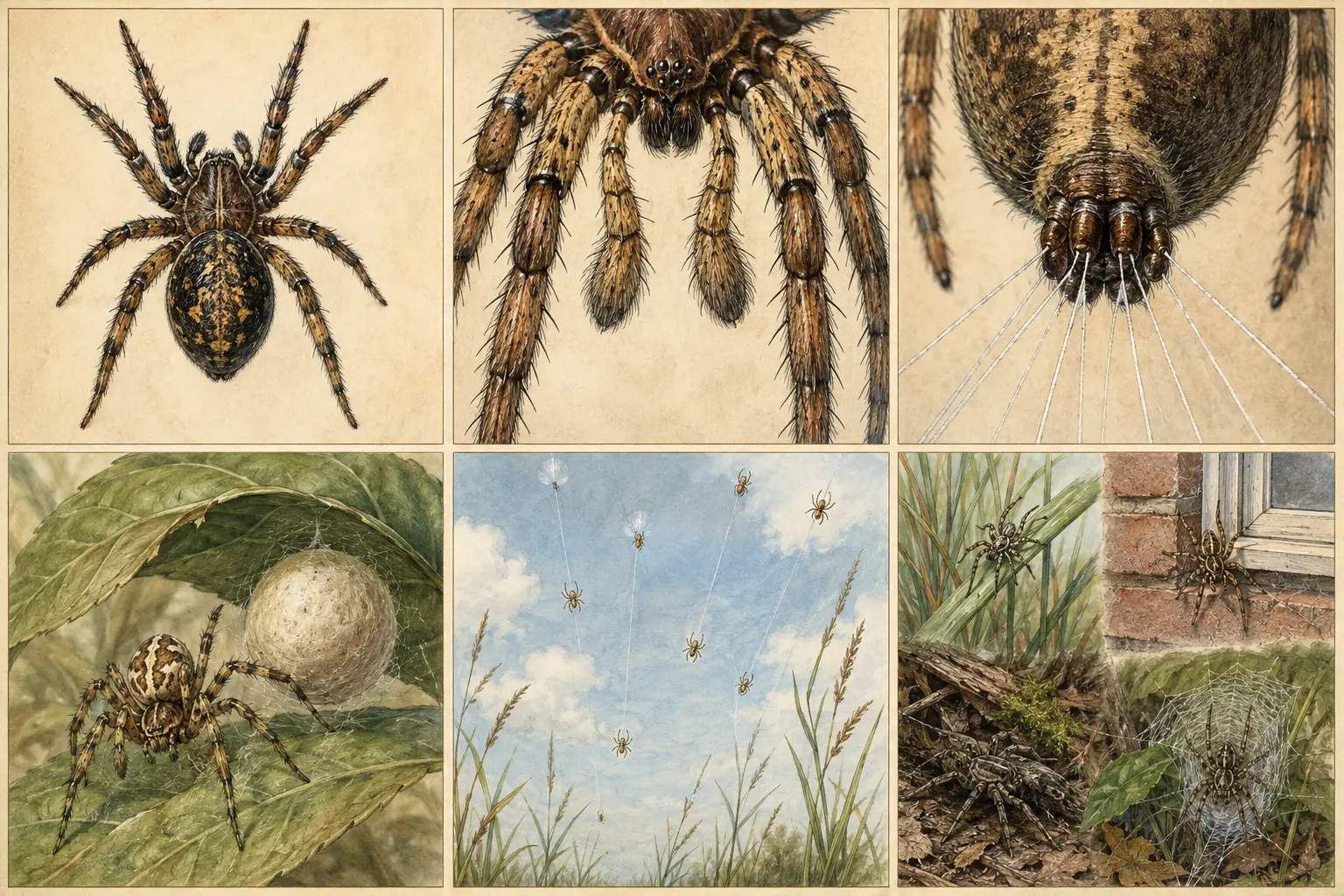
These explanatory illustrations show structures and mechanical ideas. The field photographs within the article record real spiders; each has its own species label, observation notes, photographer credit, and reuse license.
A spider’s life is not a single hunting pose frozen in a photograph. It is a sequence of stages—egg, spiderling, juvenile molts, adult—played out inside a habitat that sets the mechanical problem silk has to solve. Anchors, wind, rain, prey traffic, and shelter decide whether an orb, tangle, triangle, portable net, bolas, burrow line, or active hunt is useful.
This article expands WebTug’s development-and-habitat chapter into a standalone educational page. It stays aligned with the site’s cited overviews—Cornell on growing spiders and Smithsonian Tropical Research Institute on habitat breadth—and with the species profiles used in the game’s roster.
Why this matters
Life stage changes what silk is for. An egg sac is protection; ballooning silk is transport; juvenile webs may differ from adult webs; adult females of some species invest heavily in capture structures while males may wander. Habitat is not scenery. It is the set of supports, loads, and prey paths that make one architecture succeed and another fail. Reading spiders that way turns “cute spider game” into a clearer materials-and-structures lesson.
Stage 01 — Egg sac

Nesticodes rufipes spiderlings emerge from their silk egg sac.
Look closely: Compare the adult, the egg sac, and the much smaller young in one frame. Their clustering documents this moment of emergence; it does not mean all spider species remain together for the same length of time.
Photo: Célio Moura Neto (biologocelio) · CC BY 4.0 · Original / license record. Resized and converted to WebP; original composition retained.
A female encloses eggs in protective silk. The sac’s shape, placement, guarding behavior, and season vary by species. Some sacs hang in vegetation; others sit in retreats, under bark, in leaf litter, or against building corners. The silk casing buffers developing young and helps conceal them.
Tubuliform silk is a specialized fiber system often associated with egg-sac casing in adult females of many groups. Egg sacs can combine several silks. That is a materials detail with an ecological job: durable packaging for a vulnerable stage. WebTug’s silk-materials article covers the gland systems; here the point is simpler—silk starts protecting offspring before any capture web exists.
Stage 02 — Spiderling
Young spiders emerge with the adult body plan in miniature: two body regions, eight legs, spinnerets. They are not soft larvae waiting to invent legs later. What they still need is growth, and growth requires molting.
Behavior right after emergence differs among species. Some spiderlings remain near the sac at first. Others disperse quickly. Dispersal can mean walking to a nearby shelter—or releasing fine silk into moving air.
Ballooning as dispersal
Ballooning is the familiar name for silk-assisted aerial dispersal. Spiderlings and some small adults release fine lines that interact with air currents and electric fields, so that the animal can be carried away. Morley and Robert’s experiments found that electric fields can elicit ballooning behavior and provide lift under controlled conditions. That does not assign the same balance of forces to every outdoor event. The illustrated sequence above shows the concept qualitatively.
Ballooning is not flight with wings. It is a silk-assisted dispersal strategy involving low mass, fine fibers, and ambient aerodynamic and electrical forces. For an educational game site, the useful takeaway is that silk can support transport as well as capture.
Stage 03 — Juvenile molts

A green lynx spider (Peucetia viridans) during a molt, beside its old exoskeleton.
Look closely: The green animal hangs below the pale old covering. A shed exoskeleton can still retain the shape of legs and body, so finding one is different from finding a dead spider. This is a green lynx spider, outside the game roster.
Photo: Daniel Das (danieldas) · CC0 1.0 · Original / license record. Resized and converted to WebP; original composition retained.
A spider’s outer skeleton cannot expand continuously the way a soft-bodied animal can. Growing therefore means molting through several immature stages. Between molts, the spider feeds, builds or uses silk structures appropriate to its size, and avoids threats it cannot yet match as an adult.
Molt count, timing, and vulnerability windows differ widely among species. Cornell University’s growing-spiders exhibit is the site’s linked classroom-style guide for this arc. The important engineering note: each molt changes size and can change what supports and prey sizes are available. A juvenile’s web is solving a different load-and-prey problem than an adult’s web, even in the same habitat patch.
Stage 04 — Adult
After reaching sexual maturity, adults court and reproduce. In many familiar araneomorph spiders, the maturity molt is the last; some adult females, including tarantulas, continue molting. Timing, parental care, molt history, and life span differ widely. In some species, adult females maintain large capture webs or specialized hunting devices; adult males may be smaller, shorter-lived, or more mobile. Subadult and adult stages can also differ in hunting method—bolas spiders are a clear WebTug example, where Yeargan’s work on Mastophora hutchinsoni describes subadult and adult female moth hunting.
Adulthood is when many of the “field profile” behaviors that inspired WebTug’s visuals are easiest to observe: orb building, triangle preloading, net casting, gumfoot tangles, or sight-based jumping with a dragline. Sex matters too: mature male net-casters stop casting nets and search for mates, as the University of Florida species account explains.
Habitat as an engineering problem
Spiders occupy nearly every terrestrial habitat—deserts, forests, grasslands, caves, shorelines, gardens, and buildings—and are found on every continent except Antarctica. That breadth is not a trivia line; it is a constraint map.
Ask four engineering questions of any site:
- Where can silk be anchored? Leaves, twigs, rock, bark, building corners, and grass stems offer different stiffness and failure modes.
- What loads will the structure see? Wind and rain punish large exposed sheets; sheltered recesses favor other designs.
- Where is prey traffic? Flight paths favor orbs; ground-adjacent insects favor gumfoot lines; nocturnal moth traffic favors bolas tactics; cluttered understory may favor portable nets or active hunters.
- Where can the spider hide or wait? Retreats, leaf curls, and wall recesses change vigilance costs and web geometry.
This is an engineering reading of habitat, not a rule that one setting always produces one web type. The Smithsonian Tropical Research Institute’s spider-verse story offers habitat and diversity context. The six WebTug species summaries are short habitat notes, not complete range maps. Distributions are broader and more detailed than any one paragraph, and behavior varies with age, sex, prey, season, and local conditions.
Examples tied to the WebTug roster
- Shamrock orb-weaver (Araneus trifolium): vegetation supports for a vertical orb across an insect flight path; World Spider Catalog records Alaska, Canada, and the United States.
- Triangle weaver (Hyptiotes cavatus): wooded eastern North American supports for a triangular, preloadable web; catalog range record.
- Ogre-faced net-caster (Deinopis spinosa): nocturnal hunting in southeastern U.S. and Caribbean/northern South American records—portability matters more than a permanent aerial sheet; catalog range record.
- Bolas spider (Mastophora hutchinsoni): eastern North American vegetation where moth traffic after dark makes a chemical-and-glue tactic workable; catalog range record.
- Western black widow (Latrodectus hesperus): protected recesses across western North America—tangle webs and gumfoot lines suit sheltered geometry; catalog range record, including introductions.
- Adanson’s house jumper (Hasarius adansoni): wide introduced range in buildings and disturbed habitats; sight hunting plus dragline control instead of a prey-catching web; catalog range record.
Observe a stage without guessing an age
In the egg-sac photograph, distinguish three things: the silk casing, the clustered young, and the adult beside them. In the molt photograph, distinguish the living green spider from the pale old cuticle. These are observations you can make directly; the exact age, molt number, and eventual survival of each animal cannot be read from the images.
For a short field notebook entry, record the date, setting, visible silk structure, and what changes during a few minutes of watching. Use “young clustered around a sac” when that is what you see. Leave age or species uncertain when the evidence is missing. Photograph from where you are; leave the sac, web, retreat, and animal in place.
Compare the guarded nursery in the jumping-spider film with the other species’ egg-sac photograph. Similar life stages do not guarantee identical parental care or dispersal schedules. The Australian Museum’s account of egg sacs and dispersal describes several different ways spiders protect and distribute their young.
How WebTug maps (and doesn’t)
Maps
- Homepage Chapter 02 stages (egg sac → spiderling → juvenile molts → adult) match this article’s sequence.
- Habitat language on the site treats anchors, weather, and prey traffic as design inputs—the same framing used here.
- Species pages and profiles keep the “field guide, not range map” disclaimer.
Doesn’t
- The forest in the playable game is a readable obstacle course, not an ecological simulation of wind, rain, or seasonal prey.
- Ballooning is not part of WebTug’s control model.
- Life stage never changes in-game physics; every profile shares one acceleration rule set.
For interactive silk-use models, use the Spider Physics Lab. For how the arcade path actually updates, use game physics.
Sources
- Cornell University Library: Growing Spiders — molting, eggs, and spiderlings.
- Smithsonian Tropical Research Institute: Spider-verse — habitat and diversity context.
- Australian Museum: spider biology, habitat, and reproduction.
- Morley and Robert (2018): Electric Fields Elicit Ballooning in Spiders, Current Biology.
- Yeargan (1988): Ecology of a bolas spider, Mastophora hutchinsoni, Oecologia.
- University of Florida: Deinopis spinosa — habitat and changes at male maturity.
- World Spider Catalog species records linked individually in the roster examples above; WebTug field-guide index.