TRY THE SIX PHYSICS DEMONSTRATIONS
Adanson’s house jumper
Hasarius adansoniSpring and pendulum motion is calculated from simplified forces. Net casting combines a guided reach with elastic settling. Settings use relative units, not measured spider or silk values.
Explore the response
Percentages are relative controls. A change restarts a running experiment. While paused, it updates the same moment so you can compare.
Adanson’s house jumperHasarius adansoni
Stabilize a jump and arrest a fall
Once a safety line becomes taut, its stretch and damping can redirect or reduce motion. Experiments with jumping spiders also show draglines improving dynamic stability during a jump.
Model boundary: Gravity drives the fall. The spring–damper acts only while the line is stretched and can pull, never push. The dashed line marks the model’s resting position. Real dragline silk has nonlinear, rate- and humidity-dependent behavior.
PRIMARY RESEARCH: Chen et al., Journal of the Royal Society Interface (2013) ↗ONE CHANGE · TWO REPLAYS
What happens after the safety line becomes taut?
Keep fall distance and line stiffness unchanged. Predict which energy-loss setting produces less repeated motion after the line loads.
Original WebTug teaching demonstrations. Settings are relative percentages, not biological measurements. Notes and saved replay settings stay in this page session and are not uploaded.
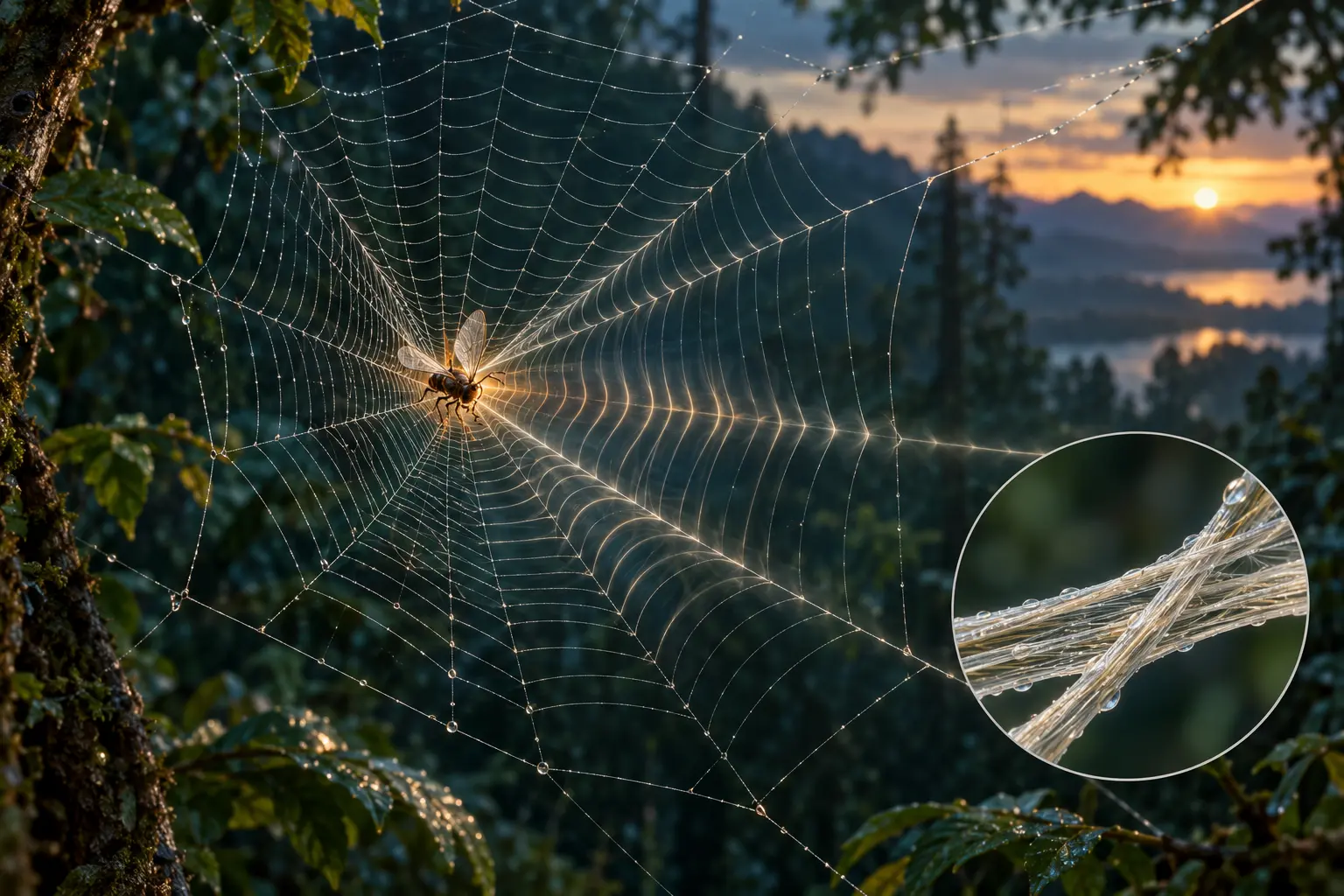
A qualitative illustration of deformation spreading through web geometry. It is not a measured simulation; the controls and source notes above state the assumptions of each teaching model.
THREE EXPERIENCES: CLASSIC, SCIENCE ARCADE, AND LAB
“Spider silk physics” is not one universal behavior. A fixed orb dissipating an insect’s impact, a preloaded triangle web releasing stored energy, a sticky bolas swinging from a line, and a dragline arresting motion are different mechanical situations. The playroom therefore changes its simplified equation and animation when you change the silk use.
WebTug Classic keeps its rules fixed. Every profile is rendered inside the same character envelope and uses the same eyes, normalized weight, collision box, held acceleration, released acceleration, speed limits, body motion, and web-travel timing. The profile changes silhouette, palette, markings, and the drawing used when silk is released—not the force produced.
WHAT “ELASTIC” MEANS HERE
An elastic thread stores recoverable energy when stretched; a damped or viscoelastic system also loses part of the motion to internal friction, air drag, structural movement, or other mechanisms. A browser model often starts with Hooke’s law, F = kΔx, but real spider silk is not a perfect linear spring. Its response depends on silk type, strain, loading speed, previous loading, humidity, and the way many threads share a load.
That is why the controls are comparative rather than claims about one species’ exact modulus. Increasing “stiffness” makes the simplified restoring force grow faster. Increasing “damping” reduces oscillation; excessive damping in a linear oscillator can slow its return to equilibrium. More damping does not always mean the fastest settling. The source and model boundary under every mode show what the visual leaves out.
SIX MODELS, SIX SOURCES
The interactive display changes when a mode is selected, but the table below lets you compare every model and its evidence at once. Each equation is a teaching model rather than a claim that a living web behaves as one perfect spring, pendulum, or damper.
| Demonstration | Species | Teaching model | Main limitation | Primary source |
|---|---|---|---|---|
| ORB IMPACT | Shamrock orb-weaver | m·x″ + c·x′ + k·x = 0 | One effective spring and damper stand in for a many-thread web whose geometry, silk types, humidity, and impact location all matter. | Sensenig et al., Journal of the Royal Society Interface (2012) |
| SLINGSHOT WEB | Triangle weaver | Eₛ = ½·k·Δx² | The lab calculates one damped spring with preload extension set by stored energy and stiffness. A real Hyptiotes web contains multiple lines and releases in repeated stages. | Han et al., Proceedings of the National Academy of Sciences (2019) |
| CASTING NET | Ogre-faced net-caster | F ≈ k·Δx; A ∝ s² | Reach sets the guided casting distance; stretch scales both mesh dimensions; settling controls elastic lag and ripples. The model does not reproduce leg hydraulics, sensing, or a three-dimensional strike. The linked experiment investigates visual prey capture, not these invented spring values. | Stafstrom and Hebets, Biology Letters (2016) |
| BOLAS SWING | Bolas spider | θ″ = −(g/L)·sin(θ) − c·θ′ | This pendulum is an instructional baseline. Real captures include active leg motion, extensible silk, glue deformation, moth flight, and contact dynamics. | Diaz and Long, Insects (2022) |
| GUMFOOT SPRING | Western black widow | a = (k·Δx − m·g) / m | The single vertical spring represents energy stored across the supporting cobweb; the gumfoot strand itself is not treated as the sole energy store. The cited attachment study supports the cobweb strategy, not the game’s invented forces for a western black widow. | Sahni et al., Nature Communications (2012) |
| DRAGLINE CONTROL | Adanson’s house jumper | m·y″ = m·g − k·e − c·y′ | Gravity drives the fall. The spring–damper acts only while the line is stretched and can pull, never push. The dashed line marks the model’s resting position. Real dragline silk has nonlinear, rate- and humidity-dependent behavior. | Chen et al., Journal of the Royal Society Interface (2013) |
Focused review of the six mechanism summaries, citation scope, and teaching boundaries: September 7, 2026. WebTug is an independent educational project, not a peer-reviewed biological simulation.
COMPARE A MODEL WITH A LIVING SPIDER
Start with a photograph or film, then choose the corresponding lab mode. Name the feature you can actually observe—an expanding net, a recoiling triangle, or a web that moves after contact. Change one lab input at a time and explain whether it changes the starting energy, restoring force, or rate of energy loss.
- Orb construction: follow supports and spokes before using the orb-impact model.
- Triangle release: compare the loaded and released positions with the slingshot demonstration.
- Net casting: observe the moving capture surface before changing the net’s stretch.
- Bolas hunting: distinguish active movement from the lab’s passive pendulum baseline.
- Widow web signaling: consider a use of silk beyond the gumfoot capture model.
- Jumping-spider development and hunting: separate visible behavior from the dragline forces measured in the linked research.
A useful lab note has three parts: what the film shows, what the model predicts when one control changes, and what extra measurement would be needed to compare the two. Similar-looking motion does not establish that the model’s stiffness or damping matches the animal.
VENOM, RISK, AND ANTIVENIN: EDUCATIONAL CONTEXT
Most spiders use venom to subdue prey, but “has venom” does not mean “poses a major medical risk to people.” Risk depends on many circumstances that this site cannot evaluate. The species-inspired skin is never a safety-identification tool; stylized colors and shapes cannot confirm a real spider.
The U.S. Food and Drug Administration lists an equine black-widow antivenin indicated for symptoms caused by Latrodectus mactans. The product is clinician-administered and is not a general treatment for every spider bite. Its official label describes venom-neutralizing globulins obtained from the serum of healthy horses immunized against black-widow venom. This is regulated laboratory production, not a process to attempt outside trained facilities.
WHY THE LAB AND CLASSIC STAY SEPARATE
Giving a black widow profile a stronger line or a jumping-spider profile a lighter body would turn an educational fact into a gameplay advantage and make scores incomparable. WebTug Classic treats each profile as character art plus a species-inspired silk cue. The six separate science arcade games turn different silk mechanisms into different challenges. The lab is where physics may change, variables may be exaggerated for visibility, and model limitations can be stated beside the demonstration.